

Breadth First Search (BFS)
Example: 1
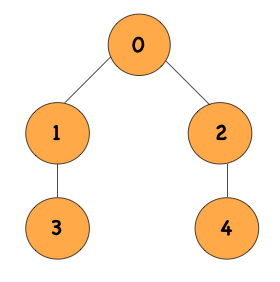
BFS: [0, 1, 2, 3, 4]
Example: 2
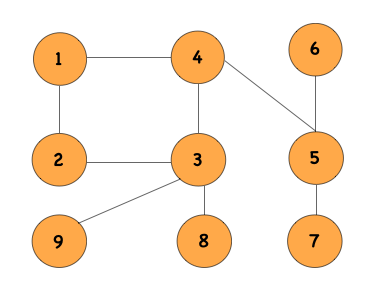
BFS: [1, 2, 4, 3, 5, 9, 8, 6, 7]
Real-World Example
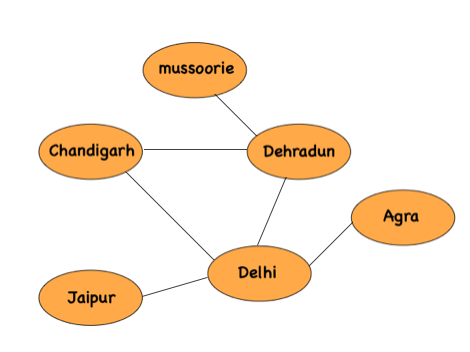
BFS: [Mussoorie, Dehradun, Chandigarh, , Delhi, Agra, Jaipur]
This solution is also considered valid.
BFS: [Mussoorie, Dehradun, Chandigarh, , Delhi, Jaipur, Agra]
We implement Breadth-First Search (BFS) using a queue data structure
Start by choosing a source node(the node from where you want to begin the traversal).Create a visited array or setto keep track of nodes you have already visited.Add the starting node to the queueand mark it as visited.- While the queue is not empty:
- Remove (poll) one node from the front of the queue.
- Check all adjacent (neighbouring) nodes of this node.
- For each adjacent node:
- If it is not visited, then:
- Mark it as visited.
- Add it to the queue.
- If it is not visited, then:
- Repeat this process until the queue becomes empty.
Problem Statement:
Given a reference of a node in a connected undirected graph.
Return a deep copy (clone) of the graph.
Each node in the graph contains a value (int) and a list (List[Node]) of its neighbors.
        class Node {
            public int val;
            public List neighbors;
        }
Test case format:
For simplicity, each node’s value is the same as the node’s index (1-indexed). For example, the first node with val == 1, the second node with val == 2, and so on. The graph is represented in the test case using an adjacency list.
An adjacency list is a collection of unordered lists used to represent a finite graph. Each list describes the set of neighbors of a node in the graph.
The given node will always be the first node with val = 1. You must return the copy of the given node as a reference to the cloned graph.
Example 1:
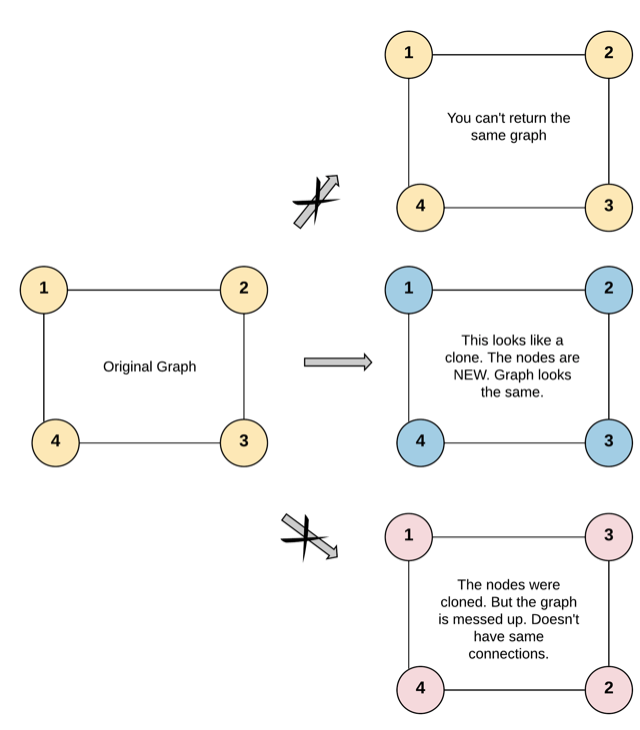
Input: adjList = [[2,4],[1,3],[2,4],[1,3]]
Output: [[2,4],[1,3],[2,4],[1,3]]
Explanation: There are 4 nodes in the graph. 1st node (val = 1)’s neighbors are 2nd node (val = 2) and 4th node (val = 4). 2nd node (val = 2)’s neighbors are 1st node (val = 1) and 3rd node (val = 3). 3rd node (val = 3)’s neighbors are 2nd node (val = 2) and 4th node (val = 4). 4th node (val = 4)’s neighbors are 1st node (val = 1) and 3rd node (val = 3).
Example 2:
Input: adjList = [[]]
Output: [[]]
Explanation: Note that the input contains one empty list. The graph consists of only one node with val = 1 and it does not have any neighbors.
Example 3:
Input: adjList = []
Output: []
Explanation: This an empty graph, it does not have any nodes.
Constraints
- The number of nodes in the graph is in the range [0, 100].
1 <= Node.val <= 100Node.valis unique for each node.- There are no repeated edges and no self-loops in the graph.
- The Graph is connected and all nodes can be visited starting from the given node.
Approach
- If the input node is NULL → return NULL.
- Create the clone of the starting node and insert it into the map.
- Use a queue (BFS):
- Push the original root node.
- While the queue is not empty:
- Pop one node curr.
- For each neighbor n of curr:
- If n is not cloned yet:
- Create a clone of n.
- Add it to the map.
- Push n into the queue.
- Add the cloned neighbor to the neighbor list of the current cloned node.
- If n is not cloned yet:
- Return the cloned root from the map.
 var cloneGraph = function(root) {
    if (!root) return null;

    const q = [root];
    const visited = new Map();
    const cloneRoot = new Node(root.val);
    visited.set(root, cloneRoot);

    while (q.length) {
        const curr = q.shift();
        const cloneCurr = visited.get(curr);

        for (const n of curr.neighbors) {
            if (!visited.has(n)) {
                visited.set(n, new Node(n.val));
                q.push(n);
            }
            cloneCurr.neighbors.push(visited.get(n));
        }
    }
    return cloneRoot;
};
from collections import deque

class Node:
    def __init__(self, val = 0, neighbors = None):
        self.val = val
        self.neighbors = neighbors if neighbors is not None else []

def cloneGraph(node: 'Node') -> 'Node':
    if not node:
        return None

    visited = {}
    q = deque([node])

    cloneRoot = Node(node.val)
    visited[node] = cloneRoot

    while q:
        curr = q.popleft()
        cloneCurr = visited[curr]

        for n in curr.neighbors:
            if n not in visited:
                visited[n] = Node(n.val)
                q.append(n)
            cloneCurr.neighbors.append(visited[n])

    return cloneRoot
import java.util.*;

class Node {
    public int val;
    public List neighbors;
    public Node() { val = 0; neighbors = new ArrayList(); }
    public Node(int _val) { val = _val; neighbors = new ArrayList(); }
    public Node(int _val, ArrayList _neighbors) { val = _val; neighbors = _neighbors; }
}

public class Solution {
    public Node cloneGraph(Node node) {
        if (node == null) return null;

        Map visited = new HashMap<>();
        Queue q = new LinkedList<>();

        Node cloneRoot = new Node(node.val);
        visited.put(node, cloneRoot);
        q.add(node);

        while (!q.isEmpty()) {
            Node curr = q.poll();
            Node cloneCurr = visited.get(curr);

            for (Node n : curr.neighbors) {
                if (!visited.containsKey(n)) {
                    visited.put(n, new Node(n.val));
                    q.add(n);
                }
                cloneCurr.neighbors.add(visited.get(n));
            }
        }
        return cloneRoot;
    }
}
#include <vector>
#include <queue>
#include <nordered_map>
using namespace std;

class Node {
public:
    int val;
    vector neighbors;
    Node() : val(0) {}
    Node(int _val) : val(_val) {}
    Node(int _val, vector _neighbors) : val(_val), neighbors(_neighbors) {}
};

Node* cloneGraph(Node* node) {
    if (!node) return nullptr;

    unordered_map visited;
    queue q;

    Node* cloneRoot = new Node(node->val);
    visited[node] = cloneRoot;
    q.push(node);

    while (!q.empty()) {
        Node* curr = q.front(); q.pop();
        Node* cloneCurr = visited[curr];

        for (Node* n : curr->neighbors) {
            if (visited.find(n) == visited.end()) {
                visited[n] = new Node(n->val);
                q.push(n);
            }
            cloneCurr->neighbors.push_back(visited[n]);
        }
    }
    return cloneRoot;
}
#include <stdio.h>
#include <stdlib.h>

typedef struct Node {
    int val;
    struct Node** neighbors;
    int neighborsCount;
} Node;

/********** Create a new node **********/
Node* createNode(int val) {
    Node* n = (Node*)malloc(sizeof(Node));
    n->val = val;
    n->neighbors = NULL;
    n->neighborsCount = 0;
    return n;
}

void addNeighbor(Node* node, Node* neigh) {
    node->neighbors = realloc(node->neighbors,
                              sizeof(Node*) * (node->neighborsCount + 1));
    node->neighbors[node->neighborsCount++] = neigh;
}
Node* findClone(Node** origs, Node** clones, int size, Node* key) {
    for (int i = 0; i < size; i++) {
        if (origs[i] == key) {
            return clones[i];
        }
    }
    return NULL;
}

void addMapping(Node*** origs, Node*** clones, int* size,
                Node* orig, Node* clone) {

    int newSize = *size + 1;

    *origs  = realloc(*origs,  newSize * sizeof(Node*));
    *clones = realloc(*clones, newSize * sizeof(Node*));

    (*origs)[*size] = orig;
    (*clones)[*size] = clone;

    *size = newSize;
}
Node* cloneGraph(Node* node) {
    if (!node) return NULL;

    // visited map arrays
    Node** origs = NULL;
    Node** clones = NULL;
    int mapSize = 0;

    // BFS queue
    int capacity = 64;
    Node** queue = malloc(sizeof(Node*) * capacity);
    int head = 0, tail = 0;

    // clone the root
    Node* cloneRoot = createNode(node->val);
    addMapping(&origs, &clones, &mapSize, node, cloneRoot);

    queue[tail++] = node;

    while (head < tail) {
        Node* curr = queue[head++];
        Node* cloneCurr = findClone(origs, clones, mapSize, curr);

        for (int i = 0; i < curr->neighborsCount; i++) {
            Node* neigh = curr->neighbors[i];
            Node* cloneNeigh = findClone(origs, clones, mapSize, neigh);

            // if not cloned yet, clone it + enqueue
            if (!cloneNeigh) {
                cloneNeigh = createNode(neigh->val);
                addMapping(&origs, &clones, &mapSize, neigh, cloneNeigh);

                if (tail == capacity) {
                    capacity *= 2;
                    queue = realloc(queue, sizeof(Node*) * capacity);
                }
                queue[tail++] = neigh;
            }

            // link clone
            addNeighbor(cloneCurr, cloneNeigh);
        }
    }

    free(queue);
    free(origs);
    free(clones);
    return cloneRoot;
}
using System.Collections.Generic;

public class Node {
    public int val;
    public IList neighbors;
    public Node() { val = 0; neighbors = new List(); }
    public Node(int _val) { val = _val; neighbors = new List(); }
    public Node(int _val, IList _neighbors) { val = _val; neighbors = _neighbors; }
}

public class Solution {
    public Node CloneGraph(Node node) {
        if (node == null) return null;

        var visited = new Dictionary();
        var q = new Queue();

        Node cloneRoot = new Node(node.val);
        visited[node] = cloneRoot;
        q.Enqueue(node);

        while (q.Count > 0) {
            var curr = q.Dequeue();
            var cloneCurr = visited[curr];

            foreach (var n in curr.neighbors) {
                if (!visited.ContainsKey(n)) {
                    visited[n] = new Node(n.val);
                    q.Enqueue(n);
                }
                cloneCurr.neighbors.Add(visited[n]);
            }
        }

        return cloneRoot;
    }
}


