

Problem Statement
Given a directed acyclic graph (DAG) of n nodes labeled from 0 to n - 1, find all possible paths from node 0 to node n – 1 and return them in any order.
The graph is given as follows: graph[i] is a list of all nodes you can visit from node i (i.e., there is a directed edge from node i to node graph[i][j]).
Example 1:

Input: graph = [[1,2],[3],[3],[]]
Output: [[0,1,3],[0,2,3]]
Explanation: There are two paths: 0 -> 1 -> 3 and 0 -> 2 -> 3. – 0 → 1 → 2 – 0 → 2
Example 2:
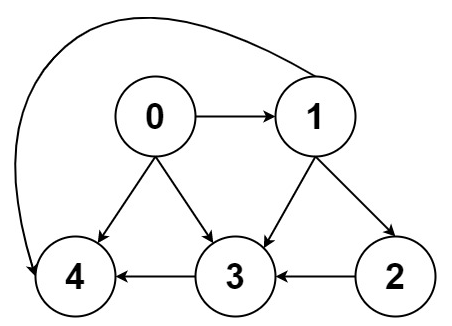
Input: graph = [[4,3,1],[3,2,4],[3],[4],[]]
Output: [[0,4],[0,3,4],[0,1,3,4],[0,1,2,3,4],[0,1,4]]
Constraints:
n == graph.length2 <= n <= 150 <= graph[i][j] < ngraph[i][j] != i(i.e., there will be no self-loops).- All the elements of
graph[i]are unique. - The input graph is guranteed to be a DAG.
Approach
- Treat the graph as a directed adjacency list.
- Start DFS from node 0 and aim to reach the last node (n − 1).
- Maintain a current path list to track the nodes visited on the current route.
- Whenever we reach the target node, store a copy of the current path in the result.
- For each neighbor of the current node,
- add the neighbor to the path,
- recursively explore it,
- then backtrack by removing the neighbor after returning.
- Return the list of all valid paths.
Dry Run
Input: graph = [[1,2],[3],[3],[]]
 Graph Structure (Adjacency List): 0 → [1, 2] 1 → [3] 2 → [3] 3 → []
    Initialize:
    start = 0
    end = 3
    allPaths = [ ]

    Start DFS: dfs(0, [0])
    • curr = 0
    • neighbors = [1, 2]

    Explore neighbor 1:
    • path = [0,1]
    dfs(1, [0,1])
    • curr = 1
    • neighbors = [3]

    Explore neighbor 3:
    • path = [0,1,3]
    dfs(3, [0,1,3])
    • curr === end → push [0,1,3] into allPaths

    Backtrack to curr = 0

    Explore neighbor 2:
    • path = [0,2]
    dfs(2, [0,2])
    • curr = 2
    • neighbors = [3]

    Explore neighbor 3:
    • path = [0,2,3]
    dfs(3, [0,2,3])
    • curr === end → push [0,2,3] into allPaths

    All neighbors of 0 explored

    Final Answer:
    allPaths = [[0,1,3], [0,2,3]]
Output: [[0,1,3],[0,2,3]]
var allPathsSourceTarget = function(graph) {
    let start = 0;
    let end = graph.length - 1;
    let allPaths = [];
    let dfs = (curr, path) => {
        if(curr === end){
            allPaths.push([...path]);
            return;
        }
        for(let neighbor of graph[curr]){
            path.push(neighbor)
            dfs(neighbor, path);
            path.pop();
        }
    }

    dfs(0, [0])
    return allPaths;
};
from typing import List

def allPathsSourceTarget(graph: List[List[int]]) -> List[List[int]]:
    target = len(graph) - 1
    res = []
    path = []
import java.util.*;

public class Solution {
    public List> allPathsSourceTarget(int[][] graph) {
        int target = graph.length - 1;
        List> res = new ArrayList<>();
        LinkedList path = new LinkedList<>();

        dfs(0, target, graph, path, res);
        return res;
    }

    private void dfs(int node, int target, int[][] graph, LinkedList path, List> res) {
        path.add(node);
        if (node == target) {
            res.add(new ArrayList<>(path));
        } else {
            for (int nei : graph[node]) {
                dfs(nei, target, graph, path, res);
            }
        }
        path.removeLast();
    }
}
    def dfs(node):
        path.append(node)
        if node == target:
            res.append(path.copy())
        else:
            for nei in graph[node]:
                dfs(nei)
        path.pop()

    dfs(0)
    return res
import java.util.*;
public class Solution {
    public List> allPathsSourceTarget(int[][] graph) {
        int target = graph.length - 1;
        List> res = new ArrayList<>();
        LinkedList path = new LinkedList<>();

        dfs(0, target, graph, path, res);
        return res;
    }
    private void dfs(int node, int target, int[][] graph, LinkedList path, List> res) {
        path.add(node);
        if (node == target) {
            res.add(new ArrayList<>(path));
        } else {
            for (int nei : graph[node]) {
                dfs(nei, target, graph, path, res);
            }
        }
        path.removeLast();
    }
}
#include <bits/stdc++.h>
using namespace std;

vector> allPathsSourceTarget(vector>& graph) {
    int target = graph.size() - 1;
    vector> allPaths;
    vector path;

    function dfs = [&](int node) {
        path.push_back(node);
        if (node == target) {
            allPaths.push_back(path);
        } else {
            for (int nei : graph[node]) {
                dfs(nei);
            }
        }
        path.pop_back();
    };

    dfs(0);
    return allPaths;
}
#include <stdlib.h>
#include <stdio.h>

static int **results = NULL;
static int *resultsCols = NULL;
static int resultsCount = 0;
static int resultsCap = 0;

void add_result(int *path, int len) {
    if (resultsCount == resultsCap) {
        resultsCap = resultsCap == 0 ? 8 : resultsCap * 2;
        results = (int**)realloc(results, resultsCap * sizeof(int*));
        resultsCols = (int*)realloc(resultsCols, resultsCap * sizeof(int));
    }
    int *copy = (int*)malloc(len * sizeof(int));
    for (int i = 0; i < len; ++i) copy[i] = path[i];
    results[resultsCount] = copy;
    resultsCols[resultsCount] = len;
    resultsCount++;
}

void dfs_c(int node, int target, int *path, int pathLen, int **graph, int *graphColSize) {
    path[pathLen++] = node;
    if (node == target) {
        add_result(path, pathLen);
    } else {
        for (int i = 0; i < graphColSize[node]; ++i) {
            int nei = graph[node][i];
            dfs_c(nei, target, path, pathLen, graph, graphColSize);
        }
    }
}

int** allPathsSourceTarget(int** graph, int graphSize, int* graphColSize, int* returnSize, int** returnColumnSizes) {
    // reset globals
    results = NULL;
    resultsCols = NULL;
    resultsCount = 0;
    resultsCap = 0;

    int target = graphSize - 1;
    int *path = (int*)malloc((graphSize + 5) * sizeof(int)); // max depth = graphSize
    dfs_c(0, target, path, 0, graph, graphColSize);
    free(path);

    *returnSize = resultsCount;
    *returnColumnSizes = resultsCols;
    return results;
}
using System;
using System.Collections.Generic;

public class Solution {
    public IList> AllPathsSourceTarget(int[][] graph) {
        int target = graph.Length - 1;
        var res = new List>();
        var path = new List();

        void Dfs(int node) {
            path.Add(node);
            if (node == target) {
                res.Add(new List(path));
            } else {
                foreach (var nei in graph[node]) {
                    Dfs(nei);
                }
            }
            path.RemoveAt(path.Count - 1);
        }

        Dfs(0);
        return res;
    }
}


