

Deadlock in Operating Systems
When multiple processes run at the same time and share resources, things can get complicated. One of the nastiest situations that can come up is a deadlock. Understanding what it is, why it happens, and how to deal with it is fundamental to OS design.
What is a Deadlock?
A deadlock is a situation where two or more processes are stuck waiting on each other indefinitely. Each process holds onto a resource that another process needs, and since nobody is willing to let go, the whole thing grinds to a halt.
The processes caught in this situation cannot move forward on their own. The operating system has to step in to resolve it.
Process P1 holds Resource R2 and is waiting for Resource R1
Process P2 holds Resource R1 and is waiting for Resource R2

Result: Neither can proceed. This is a deadlock.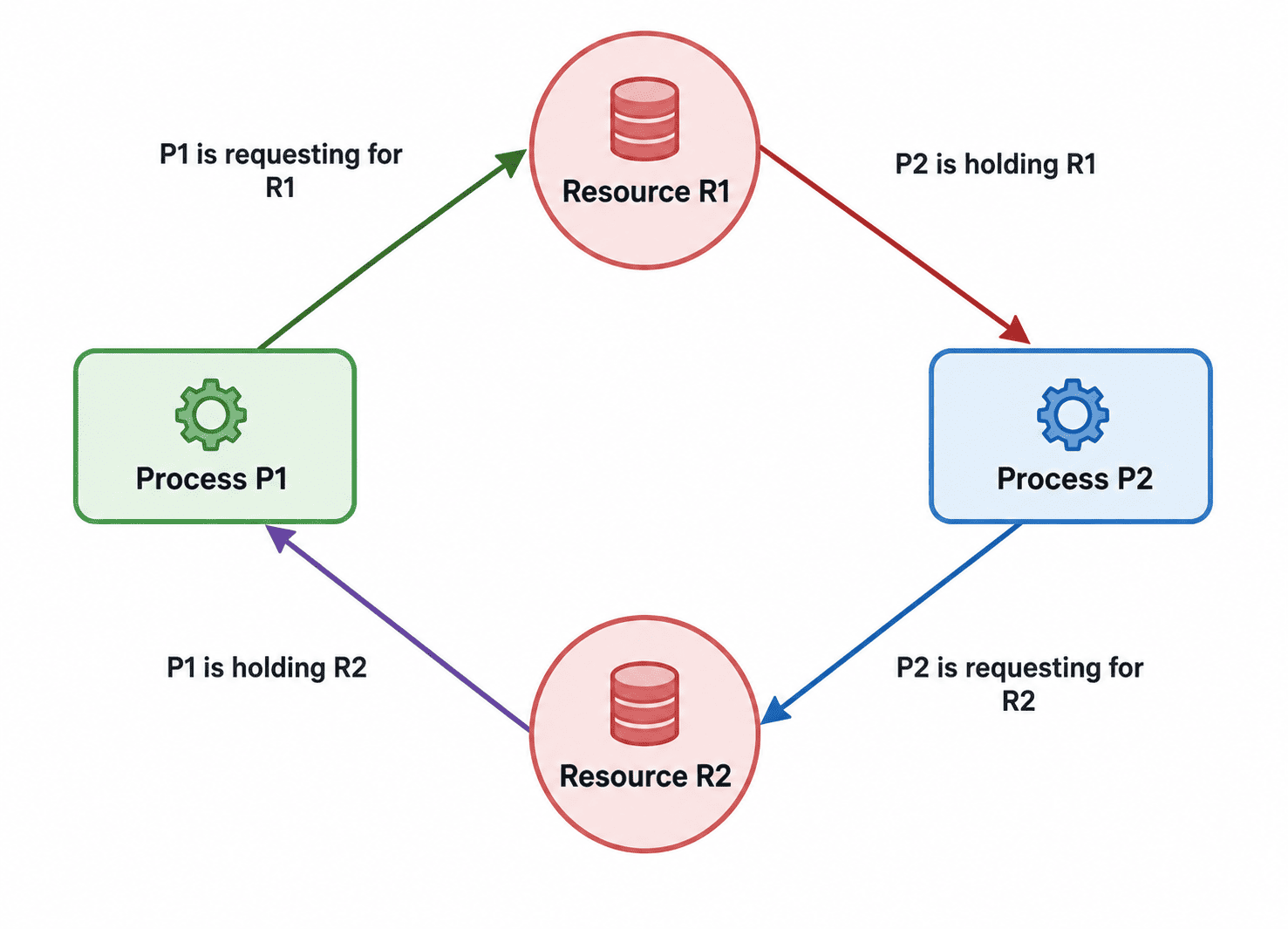
Deadlock: Two processes waiting on each other for resources, forming a cycle.
A Real-World Example
Consider two siblings, Alice and Bob, working on their homework. Alice has a Book and Bob has an Pen. Both of them need both items to finish their work, but neither is willing to hand over what they have.
Alice -> Has Book,  Needs Pen
Bob   -> Has Pen,  Needs Book

Alice -> Waiting for Bob to finish first
Bob   -> Waiting for Alice to finish first

Result: Neither finishes their homework.
This is deadlock playing out in everyday life. The concept is not unique to computers at all.
Conditions That Cause Deadlock
A deadlock cannot occur unless all four of the following conditions are true at the same time. These are famously known as the Coffman conditions.
| Condition | What It Means | Real-World Example |
|---|---|---|
| 1. Mutual Exclusion | At least one resource is being used in a way that only one process can hold it at a time. | A printer (two processes cannot print the exact same page simultaneously). |
| 2. Hold and Wait | A process is already holding one resource while waiting to get another that is currently being used by someone else. | Process A has the printer and is waiting for the scanner. Process B has the scanner and wants the printer. |
| 3. No Preemption | The system cannot forcibly take a resource away from a process. The process has to release it on its own terms. | The OS cannot just yank the printer away from Process A, even if it is blocking everyone else. |
| 4. Circular Wait | There is a chain of processes where each one is waiting for a resource held by the next, forming a closed loop. | Process A waits on B, B waits on C, and C waits on A. |
What Happens When Deadlock Occurs
Deadlocks are not just an inconvenience. They can have serious consequences on a running system:
- Wasted Resources: Resources tied up in a deadlock sit idle. No useful work gets done with them, but they are unavailable for other processes too.
- Process Starvation: Any process stuck in a deadlock never gets the resources it needs and never completes.
- System Freezes: From the outside, the system can appear completely unresponsive. Tasks stop completing, and users cannot figure out what went wrong.
How to Handle Deadlock
There are three broad approaches to dealing with deadlocks in an operating system.
| Approach | How It Works | Example |
|---|---|---|
| Prevention | Design the system so that at least one of the four Coffman conditions can never be satisfied. | Require every process to request all the resources it will ever need before it starts running (eliminates Hold and Wait). |
| Avoidance | Watch resource requests dynamically and decide whether granting them could lead toward a deadlock. | The Banker's Algorithm checks whether fulfilling a request keeps the system in a "safe state" where all processes can eventually finish. |
| Detection and Recovery | Let deadlocks happen. Run periodic checks to catch them, and deal with them once found. | Terminate one of the stuck processes or forcibly reclaim a resource (preemption) to break the cycle. |
Summary
Deadlock is a fundamental challenge in any system where multiple processes compete for shared resources. It only occurs when all four Coffman conditions line up together, which gives us a clear starting point for prevention.
Whether you stop deadlocks before they happen, steer around them dynamically, or clean them up after the fact depends on the specific needs of the system being built.