

Conditions for Deadlock in Operating Systems
Before diving into how to prevent or recover from deadlocks, it helps to understand exactly what causes them. A deadlock does not just randomly appear.
Four very specific conditions have to be present at the same time for one to occur. Remove even one of them and deadlock becomes impossible. These four conditions were identified by researchers and are known as the Coffman conditions.
1. Mutual Exclusion
Some resources can only be used by one process at a time. When a resource works this way, it is said to be non-shareable. If a second process wants the same resource while another process is using it, that second process has no choice but to sit and wait.
A printer is the most common example of this. When one application is sending pages to the printer, every other application that wants to print has to queue up and wait its turn. The printer simply cannot serve two jobs at once.
This condition on its own is not dangerous. It becomes a problem when it combines with the other three.
2. Hold and Wait
This condition comes into play when a process that already has one resource starts asking for more, while those additional resources are being held by other processes.
Consider this scenario:
Process A currently holds the printer and is asking for the scanner
Process B currently holds the scanner and is asking for the printer
Both are sitting on something the other one needs. Neither is giving anything up. This kind of situation sets the stage for a deadlock.
The key detail here is that the process does not release what it already has while it waits. It holds on and waits, hence the name.
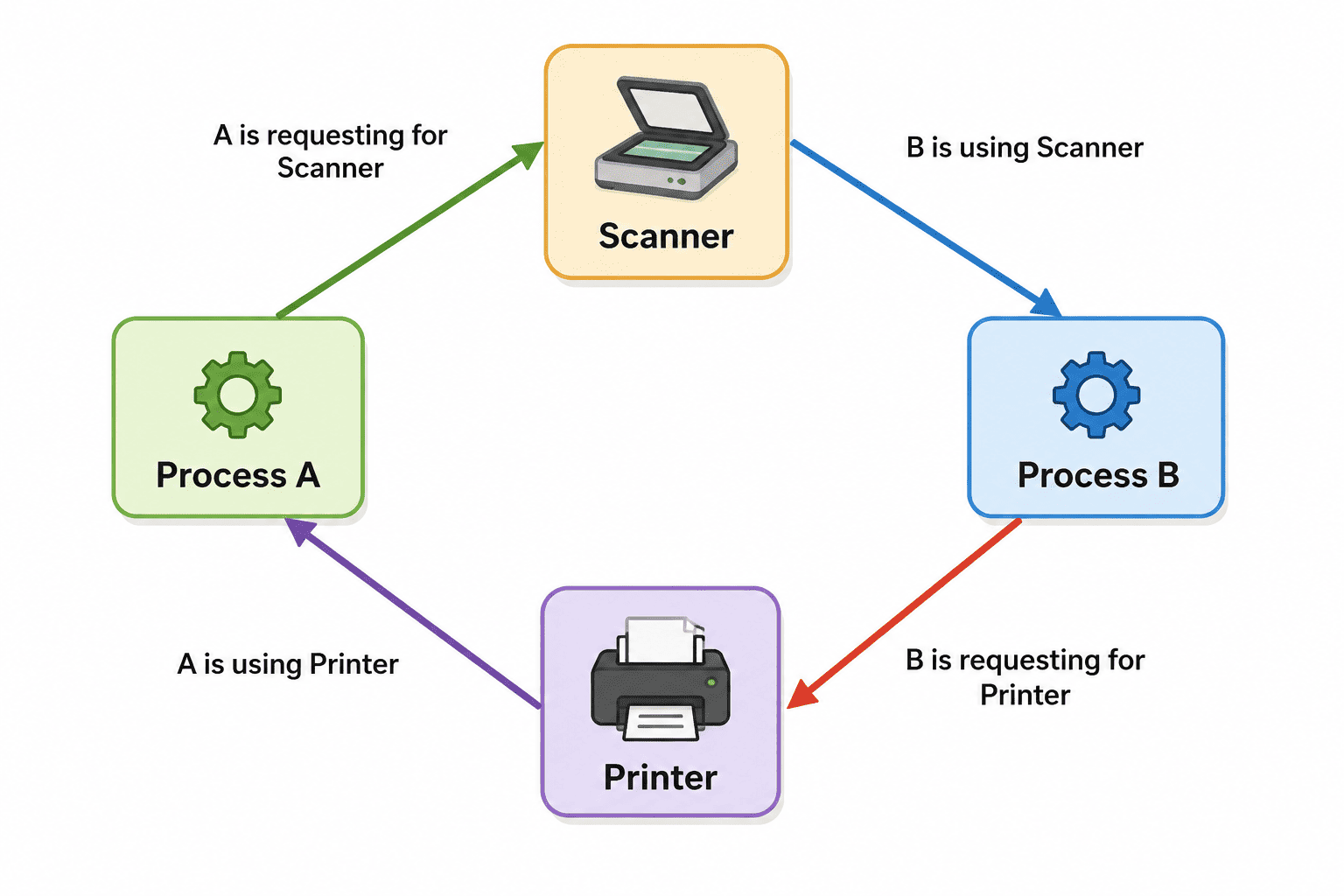
Hold and Wait: Processes hold onto their current resources while waiting for new ones to be released by others.
3. No Preemption
Preemption means forcibly taking a resource away from a process. This condition says the operating system cannot do that. A process will only give up a resource when it is finished with it and decides to release it on its own.
So if Process A is holding the printer and waiting for the scanner, the OS cannot just pull the printer away from Process A and hand it to someone else. Process A keeps it until it is done, no matter how long that takes or how many other processes are waiting.
This lack of flexibility makes it much harder to break out of waiting cycles once they form.
4. Circular Wait
This is the condition that actually closes the trap. A circular wait happens when processes form a chain where each one is waiting for a resource held by the next process in the chain, and the chain loops back on itself.
A simple three process example:
Process A is waiting for a resource held by Process B
Process B is waiting for a resource held by Process C
Process C is waiting for a resource held by Process A
Nobody in this loop can proceed. Each one is blocked by the next, and since it is a circle, there is no one at the front of the line who can finish first and free things up.
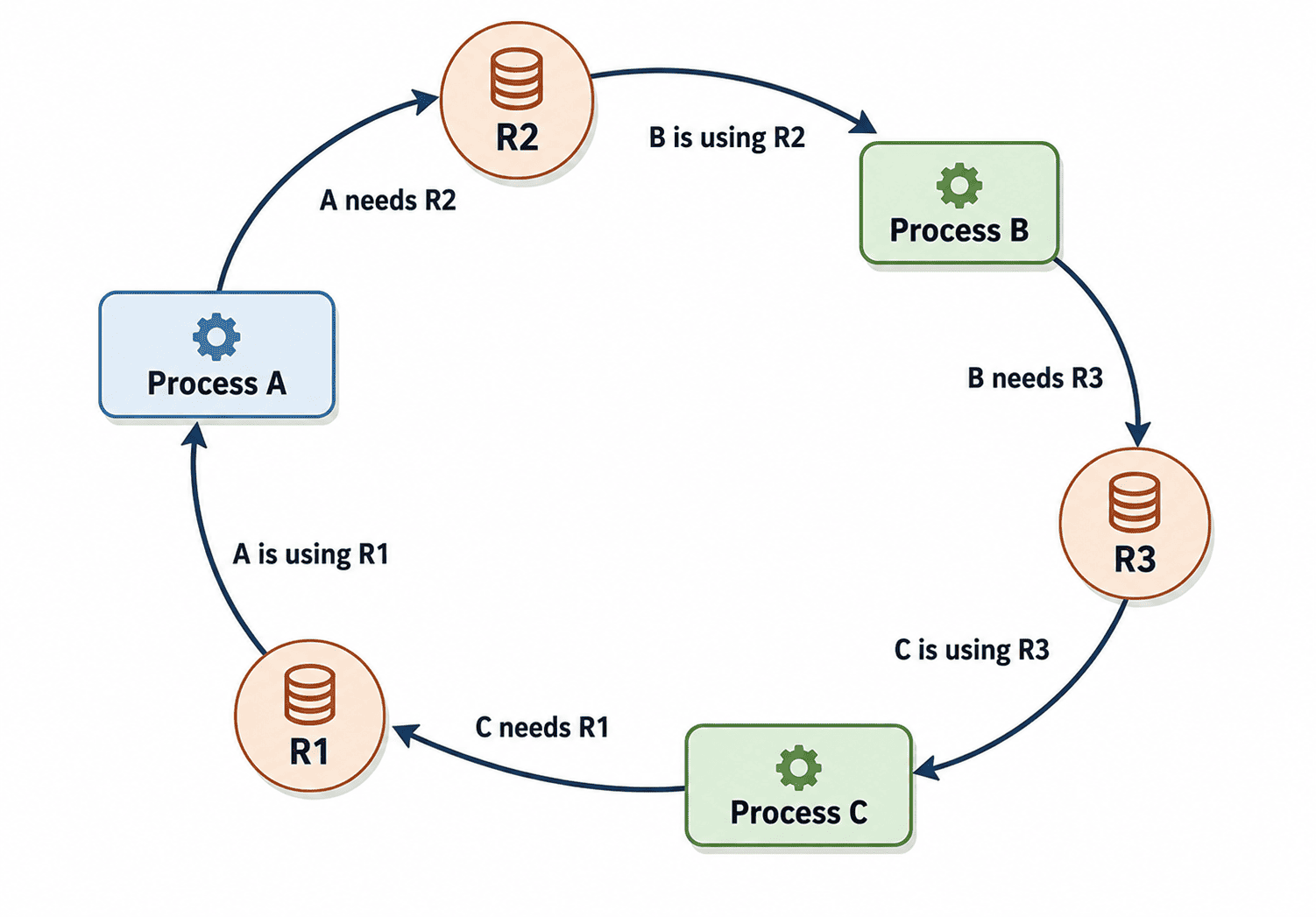
Circular Wait: A closed loop of processes waiting on each other.
Preventing Deadlock by Breaking These Conditions
Since all four conditions must hold together for a deadlock to occur, targeting even one of them is enough to keep the system safe. Here is how OS designers try to break each one:
| Condition | How to Attack It | Drawbacks |
|---|---|---|
| Mutual Exclusion | Where possible, make resources shareable (e.g., read-only files can be accessed concurrently by many processes). | Most physical hardware (printers, disk drives) cannot realistically be shared. |
| Hold and Wait | Require processes to request all resources upfront, or release everything they currently hold before asking for more. | Very wasteful. Processes hold resources longer than needed, or get starved waiting for everything to be free at once. |
| No Preemption | Allow the OS to forcibly reclaim resources. If a process gets stuck, the OS takes its resources and restarts it later. | Not all resources can be safely preempted. Preempting a printer mid-job ruins the printout. |
| Circular Wait | Number all resources globally. Force processes to always request resources in strictly increasing numerical order. | Limits flexibility for developers. Hard to assign meaningful global orderings to every possible resource. |
Summary
Deadlock is not a random event. It needs all four conditions lined up at the same time: a non-shareable resource, a process holding and waiting, no way to forcibly reclaim resources, and a circular chain of waiting.
Understanding each condition clearly is the first step toward building systems that either prevent deadlocks entirely or know how to get out of them when they do occur.