

Transmission Modes in Computer Networks
Transmission modes, also referred to as communication modes, define the mechanism by which data is exchanged between two interconnected devices over a physical communication channel.
These modes strictly specify the direction of the data flow and dictate whether devices are permitted to transmit data simultaneously or alternately. Choosing the correct transmission mode heavily influences the speed, performance, and overall architecture of a network.
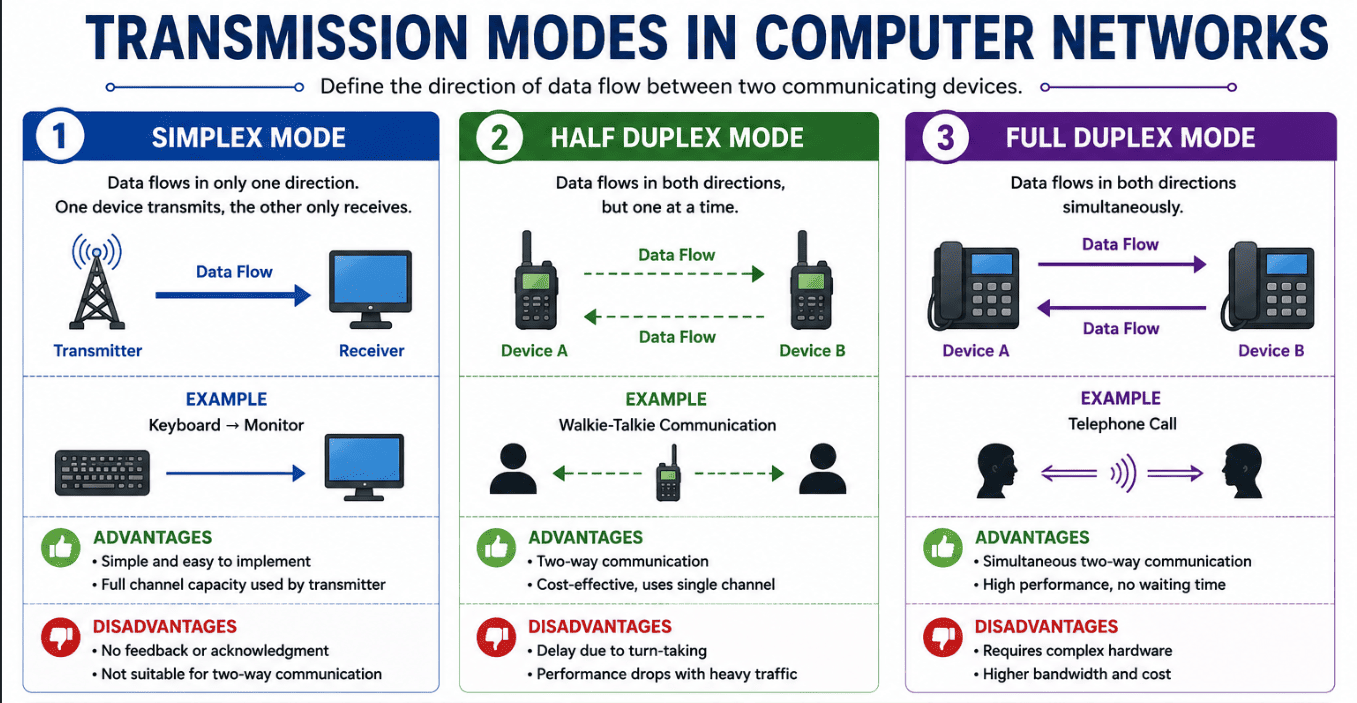
An overview of Simplex, Half Duplex, and Full Duplex transmission modes.
1. Simplex Mode
Simplex Mode is a unidirectional transmission method where communication occurs in only one direction. There is absolutely no possibility of reverse data flow.
In this configuration, one device acts exclusively as the transmitter, and the other device acts exclusively as the receiver.
- Example: A traditional computer keyboard and a monitor. The keyboard strictly sends input to the system, and the monitor strictly receives output for display.
- Advantage: Simplicity: It is highly straightforward and easy to implement.
- Advantage: Bandwidth Utilization: The transmitter utilizes the entire capacity of the communication channel for sending data.
- Disadvantage: No Feedback: It does not support error reporting or delivery acknowledgments from the receiver.
- Disadvantage: Non Interactive: It is fundamentally unsuitable for modern two-way communication systems.
2. Half Duplex Mode
Half Duplex Mode allows bidirectional communication, meaning data can flow in both directions, but strictly one at a time. Devices must take turns sending and receiving over the same shared channel.
- Example: A two-way handheld radio. One person must press a button to speak while the other listens, and they cannot both transmit audio simultaneously.
- Advantage: Flexibility: Provides two-way communication while remaining highly cost-effective compared to full duplex setups.
- Advantage: Channel Efficiency: Makes efficient use of a single shared communication channel.
- Disadvantage: Transmission Delay: There is a noticeable delay introduced by the need to take turns transmitting.
- Disadvantage: Collision Risk: Performance decreases under heavy traffic, and data collisions can occur if strict control mechanisms fail.
3. Full Duplex Mode
Full Duplex Mode permits true bidirectional communication where data is transmitted and received simultaneously. Neither device has to wait for the channel to clear before sending data.
- Example: A standard telephone network. Both individuals on a call can speak and listen at the exact same time.
- Advantage: High Performance: Offers incredibly fast data transfer rates with absolutely no waiting time between transmissions.
- Advantage: Interactivity: Highly suitable for real-time, interactive applications.
- Disadvantage: Hardware Complexity: Requires highly complex hardware and dedicated channels, increasing the configuration difficulty.
- Disadvantage: Increased Cost: The requirement for greater bandwidth and dual channels leads to significantly higher installation and maintenance costs.
Sort the Concepts
Test your knowledge! Sort these characteristics into the correct Transmission Mode bucket.