

Transmission Media
Transmission media serves as the physical or wireless communication channel responsible for carrying data signals from one device to another within a computer network.
The selection of an appropriate transmission medium is critical and depends on several factors, including the required transmission distance, the necessary data transfer speed (bandwidth), susceptibility to environmental noise, and the overall installation budget.
Classification of Transmission Media
Based on the physical nature of the transmission path, communication channels are broadly classified into two primary categories: Guided Media and Unguided Media.
1. Guided Media
Guided Media, also referred to as wired or bounded transmission media, transmits data signals through a physical path using cables. The signal is strictly confined and guided along a fixed route.
Twisted Pair Cable
A twisted pair cable consists of two individually insulated copper conductors twisted together in a helical pattern. This twisting mechanism significantly minimizes electromagnetic interference and crosstalk between adjacent pairs.
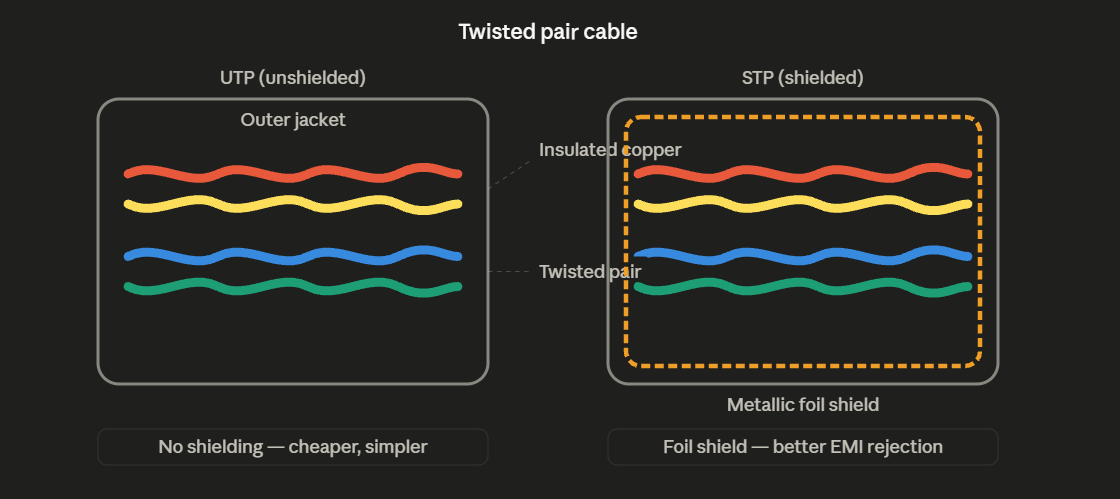
A twisted pair cable with insulated copper conductors.
- Unshielded Twisted Pair (UTP): Lacks additional metallic shielding. It is highly cost effective and easy to install, but it is limited in transmission distance and highly susceptible to electromagnetic interference.
- Shielded Twisted Pair (STP): Includes an additional metallic foil layer around the conductors. It provides superior performance and reduces interference significantly, though it is bulkier and more expensive than UTP.
Coaxial Cable
Coaxial Cable features a central copper conductor surrounded by a dielectric insulating layer, a metallic shielding layer, and a protective outer jacket. This layered structure provides robust protection against noise.
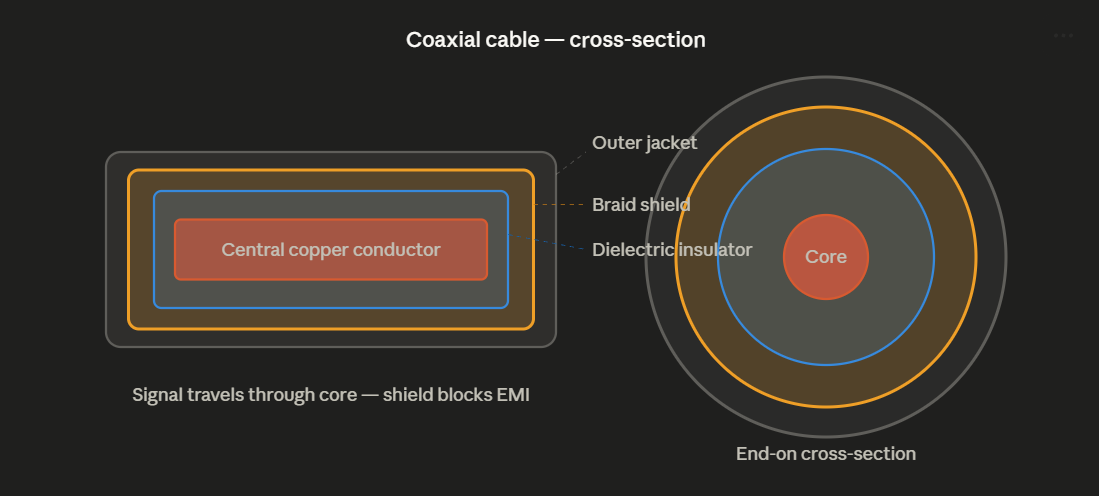
A coaxial cable showing the inner conductor, insulation, shielding, and outer jacket.
- Advantages: Offers higher bandwidth than twisted pair cables and supports both baseband and broadband transmission modes.
- Disadvantages: It is considerably more expensive, highly bulky, and requires proper electrical grounding to minimize interference.
Optical Fiber Cable
Optical Fiber Cable transmits data in the form of light signals through a highly pure glass or plastic core. It operates on the physical principle of total internal reflection.
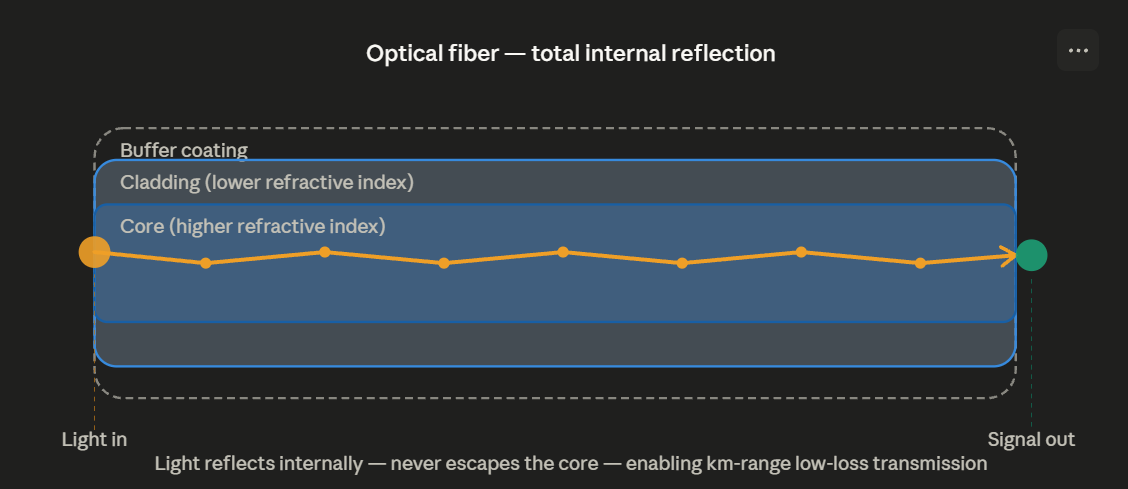
An optical fiber cable that uses light to transmit data through a glass core.
- Advantages: Provides extremely high data carrying capacity, exhibits minimal signal attenuation over immense distances, and is completely immune to electrical noise.
- Disadvantages: Installation requires highly specialized equipment and precise splicing techniques. It is also physically fragile and carries a very high initial cost.
2. Unguided Media
Unguided Media, commonly known as wireless or unbounded transmission media, utilizes electromagnetic waves to transmit data completely without a physical medium. Signals propagate freely through air or a vacuum.
Radio Waves
Radio waves can easily propagate through buildings and physical obstacles. They are perfectly suited for omnidirectional broadcast communication.
- Frequency Range: Operates between 3 kHz and 300 GHz.
- Applications: Extensively used in television broadcasting, mobile network communication, and standard wireless networking.
Microwaves
Microwave transmission requires strict line of sight communication, meaning the transmitting and receiving antennas must be perfectly aligned without physical obstructions.
- Advantages: Highly cost effective for traversing difficult terrains where laying physical cables is impossible or prohibitively expensive.
- Disadvantages: Signals are highly susceptible to severe weather conditions such as heavy rain or thick fog.
Infrared
Infrared waves are utilized strictly for short range wireless communication. Crucially, they cannot penetrate solid obstacles.
- Advantages: The inability to pass through walls provides exceptional inherent security and completely prevents interference between nearby systems in adjacent rooms.
- Applications: Used primarily in remote controls, short range peripherals, and basic data exchange between adjacent devices.
Sort the Concepts
Categorize these characteristics into Guided or Unguided media.