

Introduction to Content Delivery Networks
A Content Delivery Network (CDN) is a highly distributed group of geographically dispersed servers that work together to provide fast delivery of internet content.
Today, the vast majority of all web traffic is served through CDNs. Without them, the internet would be incredibly slow, highly susceptible to crashes, and completely unable to handle massive global events like live sports streaming.
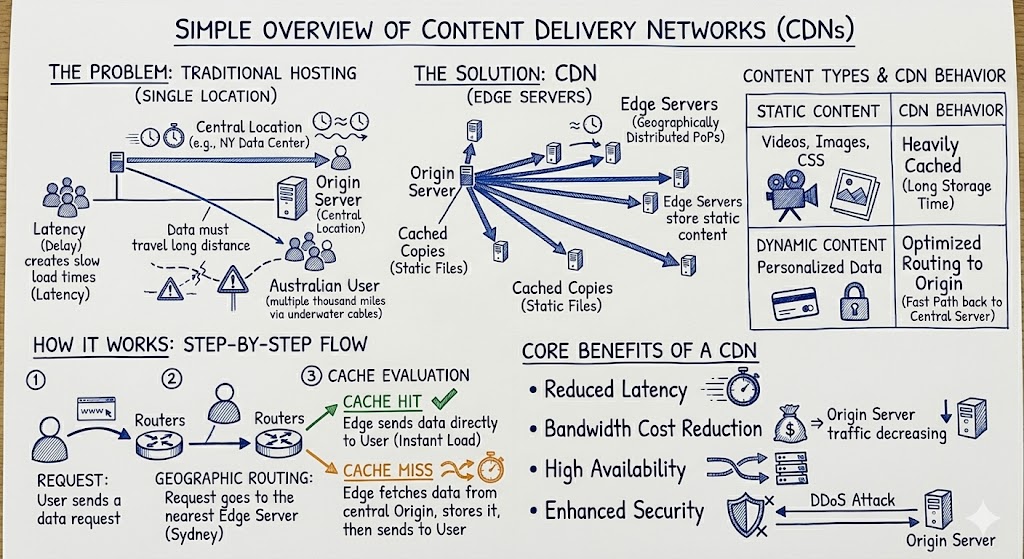
A global distribution of Edge Servers bringing content closer to users.
The Problem with Traditional Hosting
To understand why CDNs exist, we must look at traditional web hosting.
In a traditional setup, a website is hosted on a single Origin Server located in one physical location, for example, New York. If a user in New York visits the site, it loads instantly. However, if a user in Australia visits that exact same site, the data must travel thousands of miles through underwater cables, numerous routers, and multiple networks. This physical distance creates massive delay, known as latency.
The CDN Solution: Edge Servers
A CDN solves this by placing smaller, highly optimized Edge Servers in strategic geographic locations around the world, known as Points of Presence (PoPs).
Instead of forcing every user to fetch data from the single Origin Server, the CDN stores a cached copy of the website's static files (like images, videos, and styling scripts) on every single Edge Server.
How it Works Step by Step
- The Request: The user in Australia types the website URL into their browser.
- Geographic Routing: The Domain Name System (DNS) detects the user's physical location and routes their request to the absolute closest Edge Server, perhaps one located directly in Sydney.
- Cache Evaluation: The Edge Server checks its internal memory. If it already has the requested files, this is called a Cache Hit, and the files are sent to the user instantly.
- The Cache Miss: If the Edge Server does not have the files, it is called a Cache Miss. The Edge Server will quickly fetch the files from the main Origin Server in New York, send them to the user, and critically, store a copy in its cache so the next Australian user gets a Cache Hit.
Core Benefits of a CDN
- Reduced Latency: Because data physically travels a much shorter distance, websites load incredibly fast. For example, downloading a massive software update takes seconds from a local city server instead of hours from across the ocean.
- Bandwidth Cost Reduction: Web hosts charge money for data leaving the Origin Server. Because the CDN handles the vast majority of the traffic via caching, the Origin Server's bandwidth costs drop dramatically.
- High Availability and Redundancy: If a massive spike in traffic occurs, a single Origin Server would crash. A CDN absorbs this traffic across thousands of servers. If one Edge Server physically fails, traffic is instantly rerouted to the next closest server.
- Enhanced Security: Because the CDN sits directly in front of the Origin Server, it acts as a massive shield. It can absorb and block malicious traffic, specifically massive Distributed Denial of Service (DDoS) attacks, before they ever reach the main server.
Static vs Dynamic Content
It is important to note what exactly a CDN caches.
| Content Type | Definition | CDN Behavior |
|---|---|---|
| Static Content | Files that do not change from user to user, such as massive video files, high resolution images, standard HTML pages, and CSS scripts. | Heavily cached on Edge Servers for long periods of time. |
| Dynamic Content | Data generated strictly in real time for a specific user, such as a live shopping cart checkout, an active banking balance, or a personalized social media feed. | Historically not cached. Modern CDNs simply optimize the routing path back to the Origin Server to make fetching dynamic data faster. |