

Counting Sort
Counting Sort is a non-comparison based sorting algorithm. It works by counting how many times each element appears, then reconstructing the sorted array using those counts.
Best when:
Numbers are non-negative integers.
Range (max – min) is small.
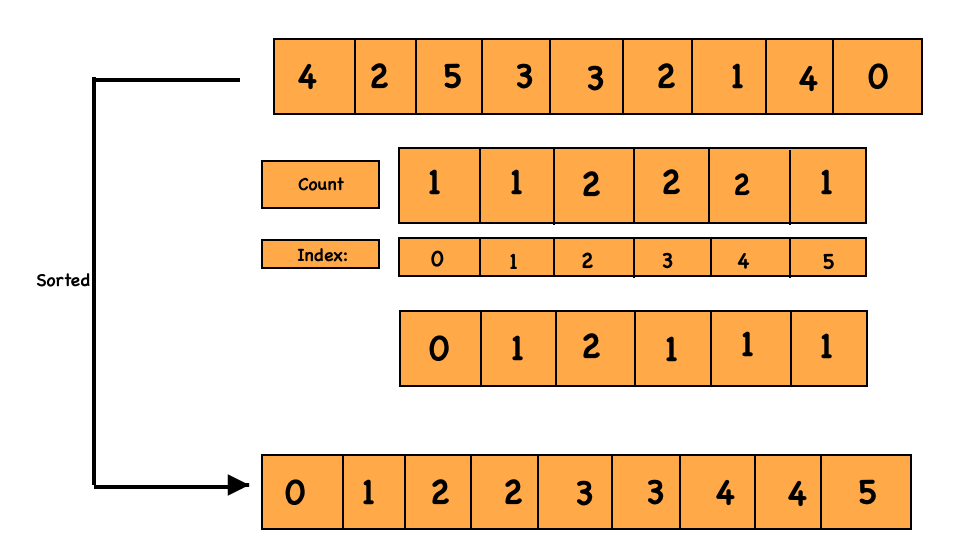
Time Complexity
O(n + k)
where k: range.
If ‘k’ (range) is small, then this algorithm is efficient.
Space Complexity
O(K)
Points to remember while using this algorithm
Elements are integers.
Values are small in range.
Examples
- Marks of students (0 to 100) (range)
- Percentages
- Sort based on Ages (0-120)
- Digits(0 – 9)
Disadvantage
Not Stable algorithm
Reasons:
- We only count frequencies.
- Then we overwrite the original array.
- We don’t remember the original order of equal elements.
- So if two elements have the same value, their relative order may change.
function countingSort(arr) {
    let max = Math.max(...arr);

    let count = new Array(max + 1).fill(0);

    for (let x of arr) {
        count[x]++;
    }

    let index = 0;
    for (let i = 0; i < count.length; i++) {
        while (count[i] > 0) {
            arr[index] = i;
            index++;
            count[i]--;
        }
    }

    return arr;
}

let nums = [4, 2, 5, 3, 3, 2, 1, 4];
console.log(countingSort(nums));
def counting_sort(arr):
    max_val = max(arr)
    count = [0] * (max_val + 1)

    for x in arr:
        count[x] += 1

    index = 0
    for i in range(len(count)):
        while count[i] > 0:
            arr[index] = i
            index += 1
            count[i] -= 1

    return arr


nums = [4, 2, 5, 3, 3, 2, 1, 4]
print(counting_sort(nums))
import java.util.*;

public class CountingSort {
    public static int[] countingSort(int[] arr) {
        int max = Arrays.stream(arr).max().getAsInt();

        int[] count = new int[max + 1];

        for (int x : arr) {
            count[x]++;
        }

        int index = 0;
        for (int i = 0; i < count.length; i++) {
            while (count[i] > 0) {
                arr[index++] = i;
                count[i]--;
            }
        }
        return arr;
    }

    public static void main(String[] args) {
        int[] nums = {4, 2, 5, 3, 3, 2, 1, 4};
        System.out.println(Arrays.toString(countingSort(nums)));
    }
}
#include <iostream>
#include <vector>
#include <algorithm>

using namespace std;

vector countingSort(vector& arr) {
    int maxVal = *max_element(arr.begin(), arr.end());

    vector count(maxVal + 1, 0);

    for (int x : arr) {
        count[x]++;
    }

    int index = 0;
    for (int i = 0; i < count.size(); i++) {
        while (count[i] > 0) {
            arr[index++] = i;
            count[i]--;
        }
    }
    return arr;
}

int main() {
    vector nums = {4, 2, 5, 3, 3, 2, 1, 4};
    nums = countingSort(nums);

    for (int x : nums)
        cout << x << " ";
}
#include <stdio.h>

void countingSort(int arr[], int n) {
    int max = arr[0];
    for (int i = 1; i < n; i++)
        if (arr[i] > max)
            max = arr[i];

    int count[max + 1];
    for (int i = 0; i <= max; i++)
        count[i] = 0;

    for (int i = 0; i < n; i++)
        count[arr[i]]++;

    int index = 0;
    for (int i = 0; i <= max; i++) {
        while (count[i] > 0) {
            arr[index++] = i;
            count[i]--;
        }
    }
}

int main() {
    int nums[] = {4, 2, 5, 3, 3, 2, 1, 4};
    int n = sizeof(nums) / sizeof(nums[0]);

    countingSort(nums, n);

    for (int i = 0; i < n; i++)
        printf("%d ", nums[i]);

    return 0;
}
using System;
using System.Linq;

class CountingSortExample {
    static int[] CountingSort(int[] arr) {
        int max = arr.Max();
        int[] count = new int[max + 1];

        foreach (int x in arr)
            count[x]++;

        int index = 0;
        for (int i = 0; i < count.Length; i++) {
            while (count[i] > 0) {
                arr[index++] = i;
                count[i]--;
            }
        }
        return arr;
    }

    static void Main() {
        int[] nums = {4, 2, 5, 3, 3, 2, 1, 4};
        nums = CountingSort(nums);
        Console.WriteLine(string.Join(" ", nums));
    }
}


