

Topological Sort
It is a linear ordering of nodes of a DAG(Directed Acyclic Graph) such that for every directed edge (u -> v), node u comes before v.
Example
An adjacency list represents a graph.
        const adj = [
            [],          // 0
            [],          // 1
            [3],         // 2 -> 3
            [1],         // 3 -> 1
            [0, 1],      // 4 -> 0, 1
            [0, 2]       // 5 -> 0, 2
        ]
Representation
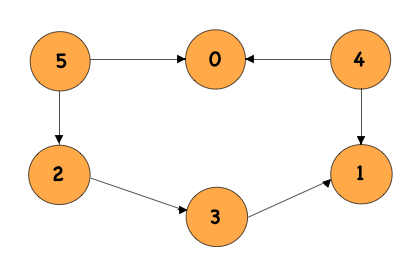
5, 0, 2, 3, 1, 4
Code
    function topologicalSortDFS(n, graph) {
    let ans = [];
    let visited = new Set();

    function dfs(curr) {
        visited.add(curr);

        for (let neighbor of graph[curr]) {
            if (!visited.has(neighbor)) {
                dfs(neighbor);
            }
        }

        ans.push(curr);
    }

    for (let i = 0; i < n; i++) {
        if (!visited.has(i)) {
            dfs(i);
        }
    }

    return ans.reverse();
}

const n = 6;
const adj = [
    [],        // 0
    [],        // 1
    [3],       // 2 -> 3
    [1],       // 3 -> 1
    [0, 1],    // 4 -> 0, 1
    [0, 2]     // 5 -> 0, 2
];

console.log(topologicalSortDFS(n, adj));
def topological_sort_dfs(n, graph):
    visited = [False] * n
    ans = []

    def dfs(curr):
        visited[curr] = True
        for neighbor in graph[curr]:
            if not visited[neighbor]:
                dfs(neighbor)
        ans.append(curr)

    for i in range(n):
        if not visited[i]:
            dfs(i)

    return ans[::-1]


n = 6
adj = [
    [],        # 0
    [],        # 1
    [3],       # 2 -> 3
    [1],       # 3 -> 1
    [0, 1],    # 4 -> 0, 1
    [0, 2]     # 5 -> 0, 2
]

print(topological_sort_dfs(n, adj))
import java.util.*;

class Solution {

    static void dfs(int curr,
                    List> graph,
                    boolean[] visited,
                    List ans) {

        visited[curr] = true;

        for (int neighbor : graph.get(curr)) {
            if (!visited[neighbor]) {
                dfs(neighbor, graph, visited, ans);
            }
        }

        ans.add(curr);
    }

    static List topologicalSort(int n, List> graph) {
        boolean[] visited = new boolean[n];
        List ans = new ArrayList<>();

        for (int i = 0; i < n; i++) {
            if (!visited[i]) {
                dfs(i, graph, visited, ans);
            }
        }

        Collections.reverse(ans);
        return ans;
    }

    public static void main(String[] args) {
        int n = 6;
        List> graph = new ArrayList<>();

        for (int i = 0; i < n; i++) {
            graph.add(new ArrayList<>());
        }

        graph.get(2).add(3);
        graph.get(3).add(1);
        graph.get(4).add(0);
        graph.get(4).add(1);
        graph.get(5).add(0);
        graph.get(5).add(2);

        System.out.println(topologicalSort(n, graph));
    }
}
#include <bits/stdc++.h>
using namespace std;

void dfs(
    int curr,
    vector>& graph,
    vector& visited,
    vector& ans
) {
    visited[curr] = true;

    for (int neighbor : graph[curr]) {
        if (!visited[neighbor]) {
            dfs(neighbor, graph, visited, ans);
        }
    }

    ans.push_back(curr);
}

vector topologicalSort(int n, vector>& graph) {
    vector visited(n, false);
    vector ans;

    for (int i = 0; i < n; i++) {
        if (!visited[i]) {
            dfs(i, graph, visited, ans);
        }
    }

    reverse(ans.begin(), ans.end());
    return ans;
}

int main() {
    int n = 6;
    vector> graph(n);

    graph[2].push_back(3);
    graph[3].push_back(1);
    graph[4].push_back(0);
    graph[4].push_back(1);
    graph[5].push_back(0);
    graph[5].push_back(2);

    vector result = topologicalSort(n, graph);

    for (int x : result) {
        cout << x << " ";
    }

    return 0;
}
#include <stdio.h>

int graph[6][2] = {
    {},        // 0
    {},        // 1
    {3},       // 2 -> 3
    {1},       // 3 -> 1
    {0, 1},    // 4 -> 0, 1
    {0, 2}     // 5 -> 0, 2
};

int size[6] = {0, 0, 1, 1, 2, 2};
int visited[6] = {0};
int ans[6];
int idx = 0;

void dfs(int curr)
{
    visited[curr] = 1;

    for (int i = 0; i < size[curr]; i++)
    {
        int neighbor = graph[curr][i];
        if (!visited[neighbor])
        {
            dfs(neighbor);
        }
    }

    ans[idx++] = curr;
}

int main()
{
    for (int i = 0; i < 6; i++)
    {
        if (!visited[i])
        {
            dfs(i);
        }
    }

    /* Reverse and print result */
    for (int i = 5; i >= 0; i--)
    {
        printf("%d ", ans[i]);
    }

    return 0;
}
using System;
using System.Collections.Generic;

class Solution
{
    static void DFS(
        int curr,
        List[] graph,
        bool[] visited,
        List ans)
    {
        visited[curr] = true;

        foreach (int neighbor in graph[curr])
        {
            if (!visited[neighbor])
            {
                DFS(neighbor, graph, visited, ans);
            }
        }

        ans.Add(curr);
    }

    static List TopologicalSort(int n, List[] graph)
    {
        bool[] visited = new bool[n];
        List ans = new List();

        for (int i = 0; i < n; i++)
        {
            if (!visited[i])
            {
                DFS(i, graph, visited, ans);
            }
        }

        ans.Reverse();
        return ans;
    }

    static void Main()
    {
        int n = 6;
        List[] graph = new List[n];

        for (int i = 0; i < n; i++)
        {
            graph[i] = new List();
        }

        graph[2].Add(3);
        graph[3].Add(1);
        graph[4].Add(0);
        graph[4].Add(1);
        graph[5].Add(0);
        graph[5].Add(2);

        var result = TopologicalSort(n, graph);
        Console.WriteLine(string.Join(" ", result));
    }
}

Add A Comment

