

Context Switching in Operating Systems
In a preemptive multitasking system, a running process may be paused before it finishes so that another process can use the CPU. This change from one process to another is known as context switching.
The context of a process includes all the information needed to continue its execution later, such as register values, program counter, stack, memory details, and other resources assigned to it.
What is Context Switching?
Context switching is the process of saving the current state of a running process and restoring the state of another process so execution can continue smoothly. This mechanism allows multiple processes to share a single CPU efficiently in a multitasking environment.
When Does Context Switching Happen?
Context switches mainly occur due to the following reasons:
- 1. Multitasking: In systems running multiple processes, the CPU switches between them to ensure fair usage. The current process is paused, its state is saved, and another process is loaded and executed.
- 2. Interrupts: When an interrupt occurs (e.g., from hardware or I/O), the system temporarily pauses the current process. Some parts of the process state are saved automatically so the interrupt can be handled quickly.
- 3. Switching Between User and Kernel Modes: A switch may occur when the system moves between user mode and kernel mode, especially during system calls.
Steps in Context Switching
The general sequence followed during a context switch is:
- Save the state of the currently running process
- Update its Process Control Block (PCB)
- Move it to the appropriate queue (ready, waiting, etc.)
- Choose another process for execution
- Update the PCB of the selected process
- Adjust memory-related data if needed
- Restore the saved state of the new process and resume execution
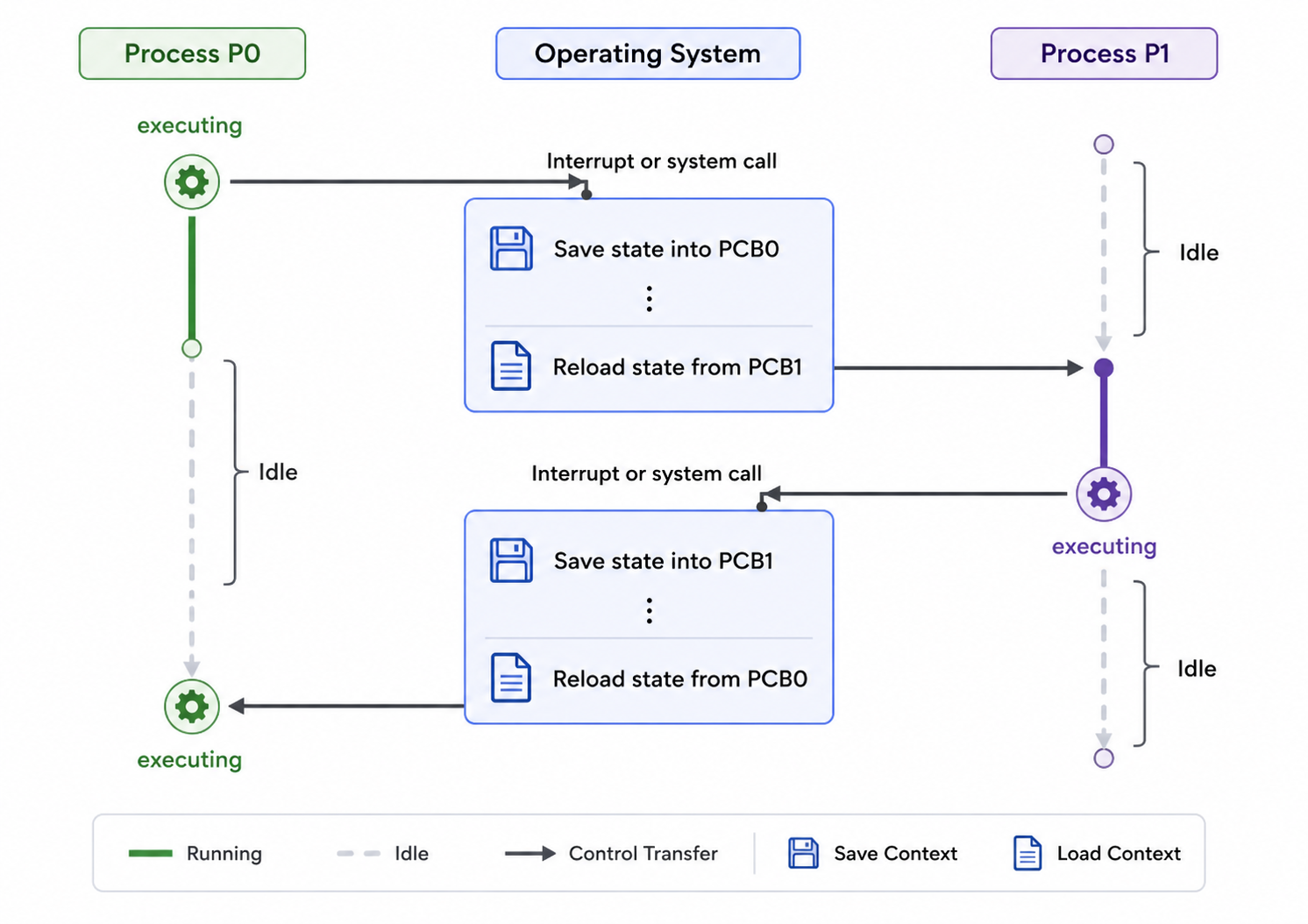
Visual representation of context switching between processes
Example
Cost and Performance Impact
Context switching is not free; it requires CPU time and system resources. The system must save and reload process states, update memory structures, and manage scheduling data.
The time taken to switch from one process to another is called context switch latency.
Frequent context switching can reduce system performance because the CPU spends more time switching rather than executing processes. Efficient scheduling aims to minimize unnecessary switches so that most CPU time is used for actual computation.
Systems that share a common address space among processes can perform context switches faster compared to those that maintain separate address spaces for each process.