

Distributed Operating Systems
Modern computing rarely happens in isolation. Many real-world applications require several machines to collaborate toward a shared objective, and this is precisely the problem that distributed operating systems are built to solve.
What Is a Distributed Operating System?
A distributed operating system manages a group of networked computers and presents them to end users as though they were one unified machine. Each participating computer in this setup is referred to as a node. Together, these nodes pool their storage, computing power, and data to deliver a seamless experience.
Think of an online multiplayer game. Millions of players connect simultaneously, and behind the scenes, hundreds of servers spread across different locations handle game logic, player data, and real-time communication. No single machine could handle all of that alone, yet the player experiences it as one connected world.
The Building Blocks
Several components form the architecture of a distributed system:
- Workstation: A regular computer through which a user interacts with the system. It has its own interface and local computing ability.
- Terminal: A lightweight device with no real processing power. It relies entirely on remote machines to do the heavy lifting and simply displays output.
- File Server: A dedicated machine responsible for storing and organizing files centrally so that every node can access them.
- Database Server: Handles database-related operations like transactions and data consistency across the network.
- Compute Node: A general-purpose machine that takes on processing tasks for larger applications.
- Communication Network: The underlying infrastructure (LAN or WAN) that ties all components together.
How It Actually Works
The foundation of a distributed operating system is loose coupling. Nodes operate independently but stay in constant communication. Key principles include:
- No Shared Memory: Each node has its own dedicated RAM. Nodes cannot directly access each other's storage.
- Message-Based Communication: Since memory is not shared, nodes exchange information by sending messages across the network.
- Workload Distribution: The OS assigns tasks based on node availability. A large job is broken up and spread across several nodes.
- Resilience to Failures: If one node crashes, the system stays alive. Pending tasks are automatically reassigned to other functioning nodes.
Architecture Models
Client-Server Model
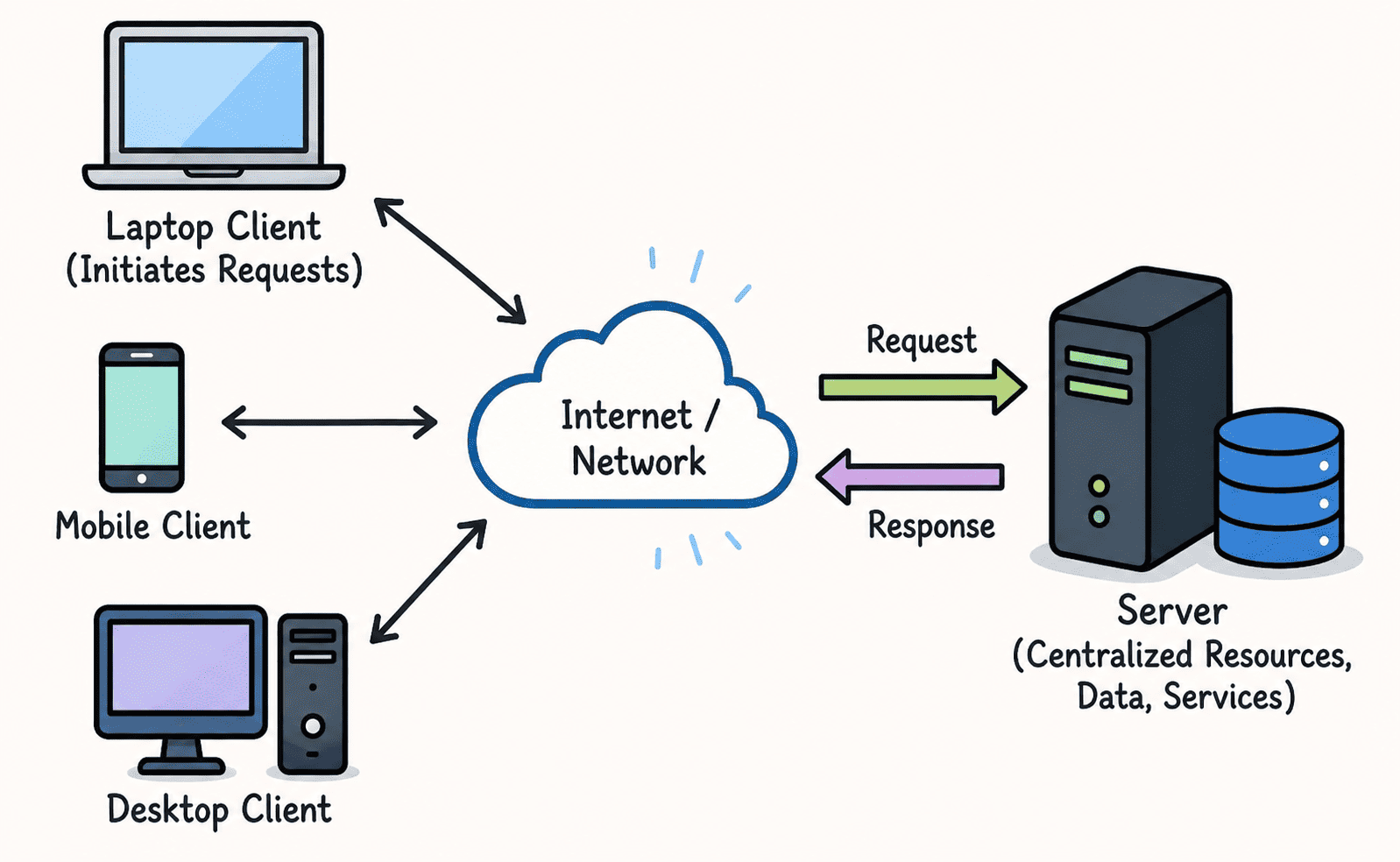
In this model, central servers provide services and data to multiple client nodes.
In this model, certain machines are designated as servers and others act as clients. Clients send requests, and servers respond with the appropriate service. This model powers most of our daily web infrastructure, including email, banking, and cloud storage.
Peer-to-Peer Model
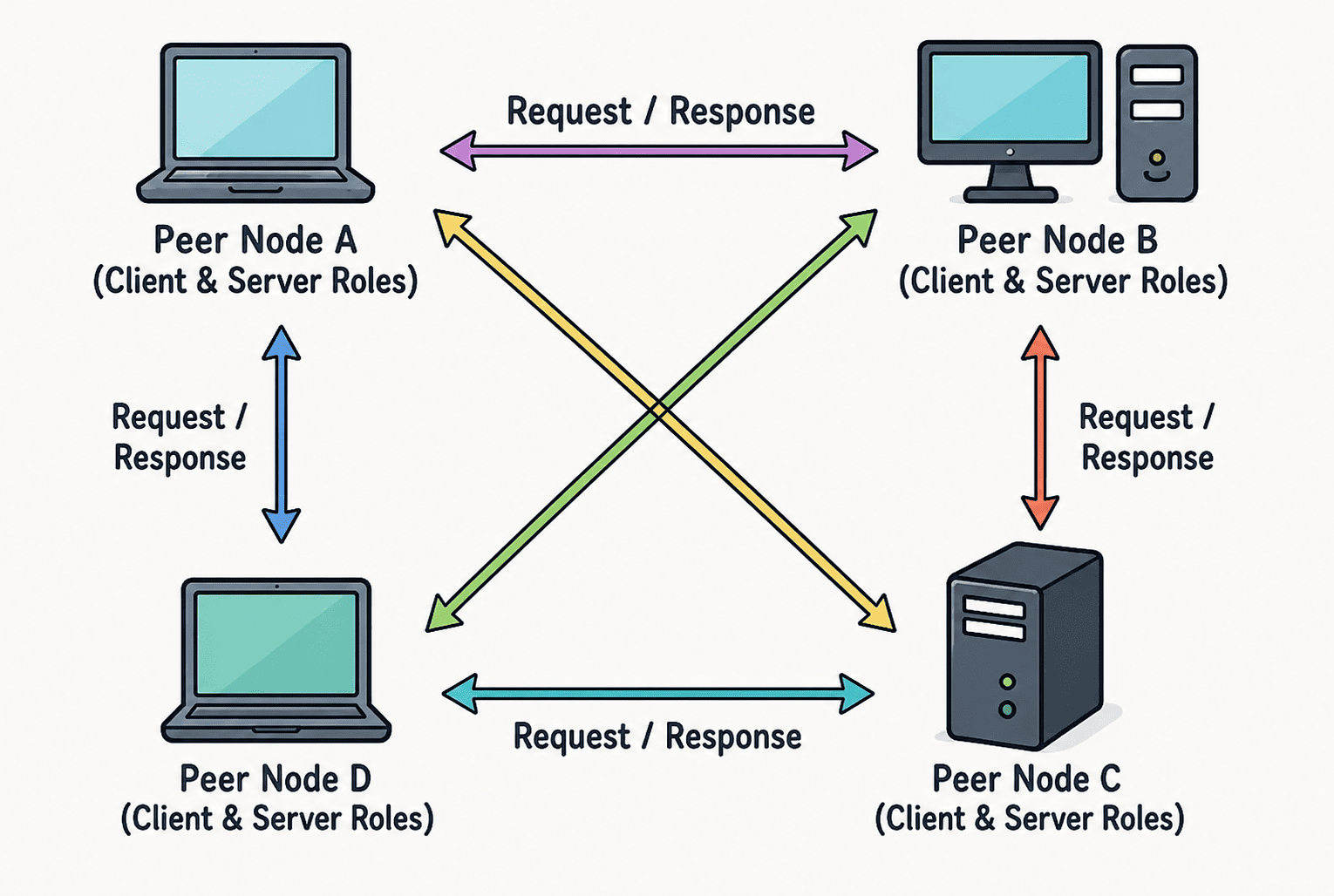
Every node in a peer-to-peer network acts as both a client and a server.
There are no dedicated servers here. Every node is equally capable of both requesting and providing services. BitTorrent is a well known example where users download and upload files directly from each other. Blockchain networks also follow this decentralized model.
Why Use a Distributed OS?
| Benefit | Description |
|---|---|
| Scalability | Adding capacity is as simple as connecting more nodes to the network. |
| Fault Tolerance | The system continues to operate even when individual components fail. |
| Resource Sharing | Computing power and storage are shared across the network rather than sitting idle. |
| Transparency | Users interact with what feels like a single machine, unaware of the complex orchestration. |
Summary
Distributed operating systems allow collections of independent computers to work as one cohesive unit. They unlock massive scale and reliability that no single machine can offer, forming the backbone of modern cloud computing and decentralized networks.