

Resource Allocation Graph (RAG) Deep Dive
To properly manage deadlocks, an operating system needs a clear, mathematical way to track which processes are holding which resources, and which processes are waiting for them.
The most effective way to visualize and analyze this state is through a Resource Allocation Graph (RAG). It translates the abstract state of the system into a directed graph that algorithms can easily traverse.
Structure of a RAG
A Resource Allocation Graph consists of a set of vertices (nodes) and a set of directed edges.
The Vertices
- Process Vertices: Represented as circles. (e.g., P1, P2)
- Resource Vertices: Represented as rectangles. Inside the rectangle, small dots represent the number of instances that resource has. If a printer resource has 3 dots, the system has 3 identical printers.
The Edges
- Request Edge (Process -> Resource): An arrow pointing from a circle (process) to a rectangle (resource). It means the process has requested an instance of that resource and is currently waiting for it.
- Assignment Edge (Resource -> Process): An arrow pointing from a dot inside the rectangle (resource instance) to a circle (process). It means that specific instance has been allocated to the process.
The Golden Rules of Cycle Detection
Detecting a deadlock using a RAG entirely depends on finding cycles (loops) in the directed graph. However, finding a cycle does not always mean there is a deadlock. You must follow three distinct rules:
| Graph State | Resource Instances | Conclusion |
|---|---|---|
| No Cycle exists | Single or Multiple | NO DEADLOCK. The system is completely safe. |
| Cycle exists | Exactly ONE instance per resource type | DEADLOCK. A cycle in a single-instance system guarantees a deadlock. |
| Cycle exists | MULTIPLE instances per resource type | POSSIBLE DEADLOCK. A cycle is necessary, but not sufficient, for a deadlock here. |
Single-Instance Resource Allocation
Let's look at a graph where every resource type has only one instance (one dot per rectangle).
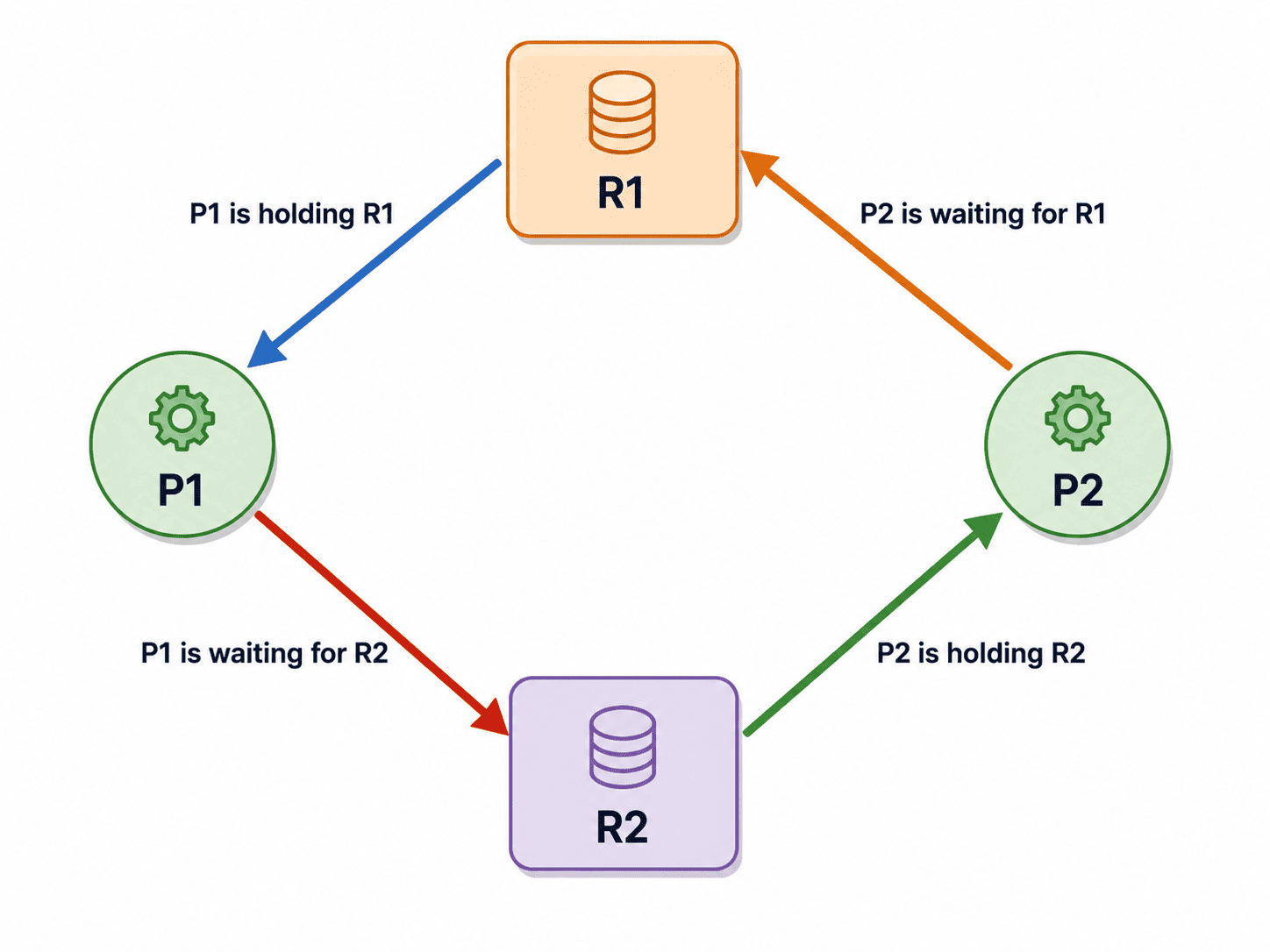
Single-Instance RAG: A cycle here guarantees a deadlock.
If we trace the edges in this graph, we might find a path that loops back on itself. For example:
P1 -> requests -> R1
R1 -> assigned to -> P2
P2 -> requests -> R2
R2 -> assigned to -> P1

Cycle: P1 -> R1 -> P2 -> R2 -> P1
Because R1 and R2 only have one instance each, and those instances are already assigned to processes within the loop, no outside process can ever intervene to free them. This is a confirmed deadlock.
Multiple-Instance Resource Allocation
Things get tricky when resources have multiple instances. A cycle might exist, but the system might still be safe.
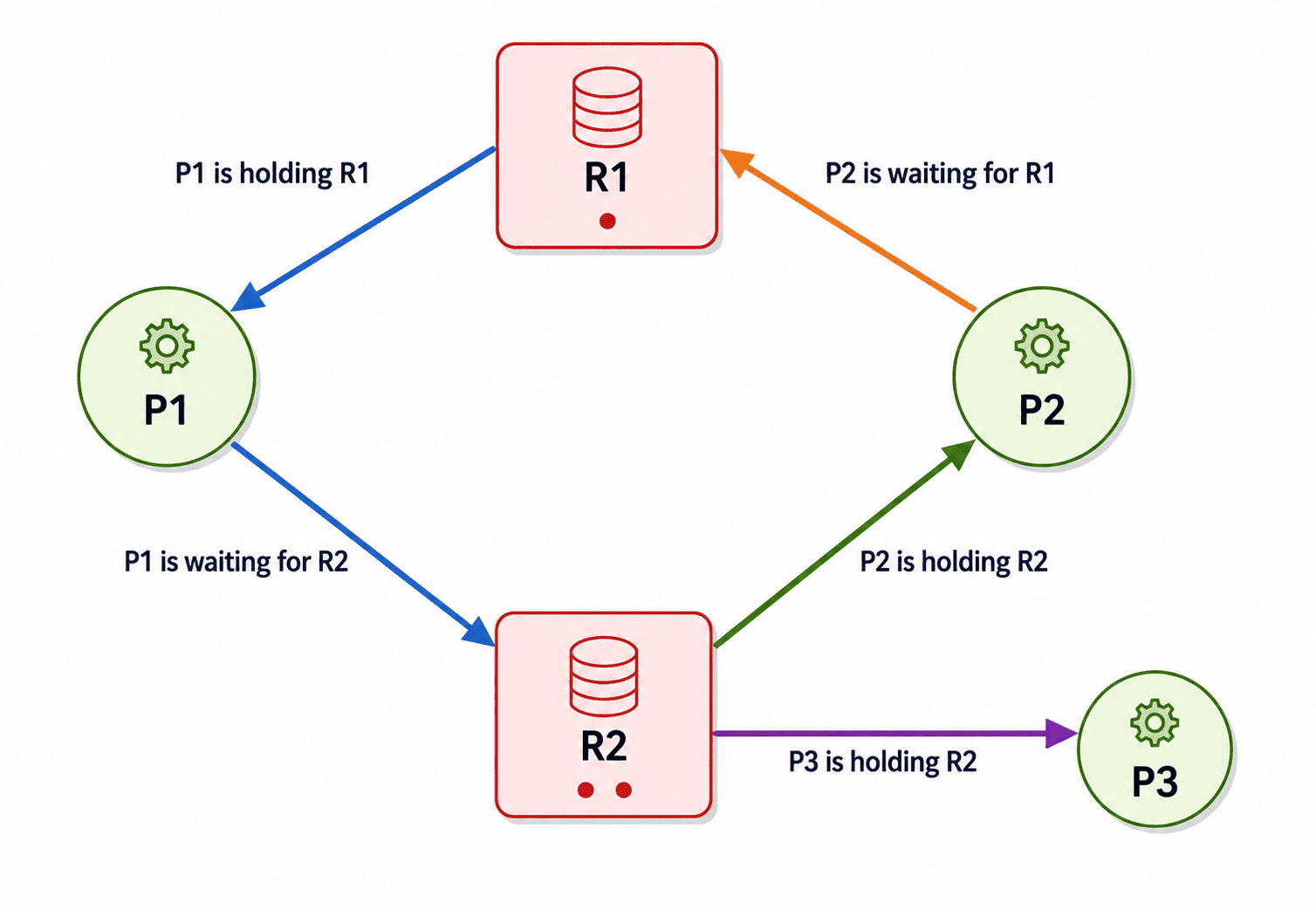
Multiple-Instance RAG: A cycle exists, but it does not guarantee a deadlock.
Imagine a cycle between P1 and P2 involving Resource R1 and R2. However, R1 has TWO instances. One is assigned to P2 (part of the cycle), but the other is assigned to P3 (who is outside the cycle).
The Cycle: P1 -> R1 -> P2 -> R2 -> P1

But look at P3:
R1 (Instance 2) -> assigned to -> P3
P3 is NOT waiting for anything else.Summary
The Resource Allocation Graph is a powerful visual and programmatic tool for deadlock detection.
If you are dealing with single-instance resources, simple cycle detection algorithms (like Depth-First Search) are enough. The moment you detect a cycle, you know you have a deadlock.
However, in modern systems where resources often have multiple instances, the RAG can only warn you of a *potential* problem. To definitively confirm a deadlock in a multiple-instance system, the OS must rely on more complex logic, like the Banker's Algorithm.
RAG Rule Application
Question 1 of 1Test your understanding of RAG cycle detection rules.