

The Critical Section Problem
Any time you have multiple processes running concurrently and sharing data, you will eventually run into the question of who gets to touch that data and when. That is essentially what the critical section problem is about.
A critical section is a piece of code that accesses shared variables or resources. The rule is simple: only one process should be inside that section at any given time. If two processes read and write the same variable simultaneously without any coordination, the result can be completely unpredictable. You might get a value that reflects only one of the writes, or something in between, or something that makes no sense at all.
Structure of a Critical Section
The typical structure around a critical section has three distinct parts that every process must follow:
do {
    +---------------------+
    |   Entry Section     |  -> Process requests permission to enter
    +---------------------+
    |                     |
    |  Critical Section   |  -> Shared resource is accessed here
    |                     |
    +---------------------+
    |   Exit Section      |  -> Process signals it is done, releases lock
    +---------------------+
    |                     |
    |  Remainder Section  |  -> Non-critical code continues
    |                     |
    +---------------------+
} while (true);
The Entry Section is where a process requests permission to enter. It checks whether the critical section is currently occupied and waits if it is. The Critical Section itself is the block of code that reads or modifies shared data. The Exit Section is where the process signals that it is done and releases whatever lock it was holding so the next waiting process can go in. Finally, the Remainder Section is everything else the process does that has nothing to do with shared resources.
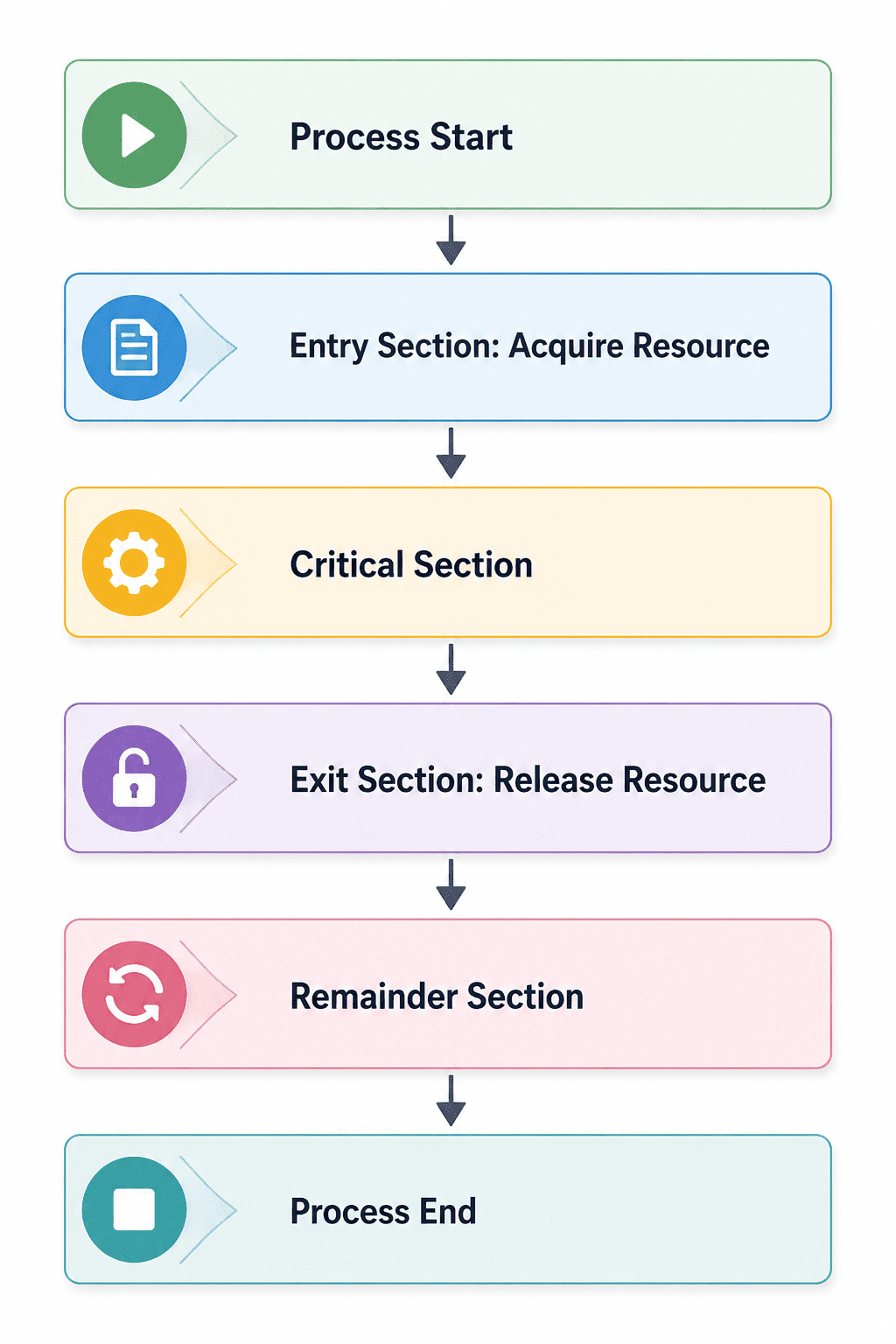
The flow of a process through Entry, Critical, Exit, and Remainder sections
The Three Requirements of a Valid Solution
Not just any approach counts as a proper solution to the critical section problem. For a solution to be considered correct, it must satisfy all three of the following conditions simultaneously. Missing even one means the solution is broken.
1. Mutual Exclusion
Only one process can be in the critical section at a time, no exceptions. If Process A is inside, every other process must wait outside until A finishes and exits. This is the most fundamental requirement. Without it, shared data gets corrupted.
2. Progress
If the critical section is currently empty and one or more processes want to enter, the system must allow one of them in. The decision about which process enters next cannot be postponed indefinitely.
Crucially, only processes that are actively trying to enter the critical section should participate in this decision. Processes that are busy with their own remainder section and have no interest in the shared resource should have zero say in who goes next.
3. Bounded Waiting
There must be a limit on the number of times other processes are allowed to enter the critical section after a process has made a request and before that request is granted. In other words, no process should wait forever.
Without this guarantee, a process could theoretically be perpetually skipped while others keep jumping ahead of it. This is the starvation problem, and bounded waiting is specifically designed to prevent it.
How It Is Solved in Practice
The most common approach is using semaphores or mutexes. Before entering the critical section, a process calls wait() on the semaphore associated with the shared resource. If the resource is free (semaphore value is positive), the process decrements the semaphore and enters. If the resource is occupied (semaphore value is zero or negative), the process is blocked and placed in a waiting queue.
Once a process finishes its critical section, it calls signal() on the semaphore, which increments the value and wakes up the next process in the waiting queue. This approach keeps things orderly without requiring the processes themselves to know anything about each other. They just interact with the semaphore, and the semaphore handles all the coordination.
semaphore mutex = 1;    // Binary semaphore, initially unlocked

void process() {
    while (true) {
        wait(mutex);        // Entry Section: request access

        // --- Critical Section ---
        // Access shared resource safely

        signal(mutex);      // Exit Section: release access

        // --- Remainder Section ---
        // Do other non-critical work
    }
}
Why Does This Matter?
Handling the critical section problem properly has tangible benefits that go beyond just academic correctness:
- Reduces wasted CPU time by making processes wait in a controlled queue rather than burning cycles in a busy-waiting loop checking over and over.
- Guarantees mutual exclusion, so shared data stays consistent and does not get corrupted by simultaneous access from multiple processes.
- Simplifies synchronization across the entire system. Once you have a well-defined critical section with controlled entry and exit, you do not need scattered locks and checks throughout your codebase.
- Prevents starvation through bounded waiting, ensuring every process eventually gets its turn regardless of system load.
Getting this right is one of the more fundamental challenges in concurrent programming. Most synchronization tools that exist, whether semaphores, mutexes, monitors, or condition variables, are ultimately just different ways of solving this same critical section problem.