

Introduction to Routing
Network routing is the fundamental process of selecting the absolute best path for data packets to travel from a source to a destination across interconnected networks.
This massive operation is managed by a Router, a specialized Layer 3 device. The router analyzes the destination IP address embedded in each packet header and makes intelligent forwarding decisions based on complex routing tables.
The Step by Step Working Principle
- Packetization: Data is broken down into small packets, and every single packet is tagged with the precise destination IP address.
- Table Lookup: The nearest router receives the packet, checks its internal routing table, and mathematically determines the shortest or most efficient path.
- Hopping: The packet travels from one router to the next, known as a hop. Every packet has a strict hop limit. If the limit is exceeded, the packet is instantly dropped to prevent infinite loops.
- Reassembly: The packets finally arrive at the intended destination where they are checked for errors and reassembled into the original data.
Different Types of Routing
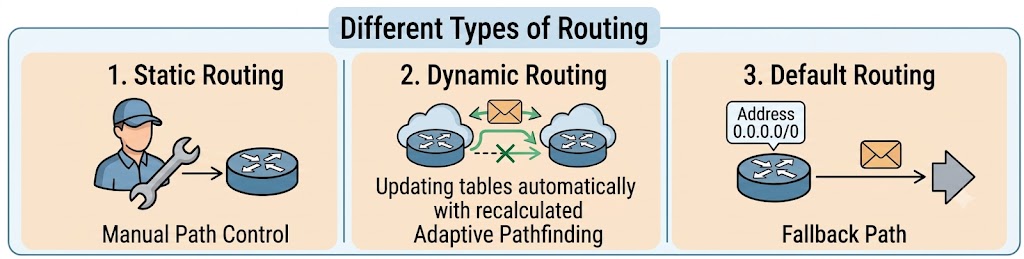
An overview of Static, Dynamic, and Default routing methods.
- Static Routing: A non adaptive method where a network administrator manually programs every route into the router. It provides ultimate security and control but is highly impractical for large networks.
- Dynamic Routing: An adaptive method where routers use mathematical algorithms to continuously discover networks and update their tables automatically. For example, if a cable is cut, the router instantly calculates a new alternative path.
- Default Routing: A fallback method used when a router does not know the specific path to a destination. The packet is blindly forwarded to a single predefined exit point using the address 0.0.0.0/0.
Routing Strategies and Algorithms
Dynamic routing protocols primarily fall into two major architectural categories, each using a different mathematical algorithm to solve pathing problems.
Distance Vector Routing
In Distance Vector Routing, every router blindly shares its entire routing table exclusively with its immediate, directly connected neighbors at regular time intervals.
It relies on the Bellman Ford algorithm. The primary metric used to calculate the best path is simply the Hop Count (the number of routers to cross). It is generally slow to update and not suitable for massive networks.
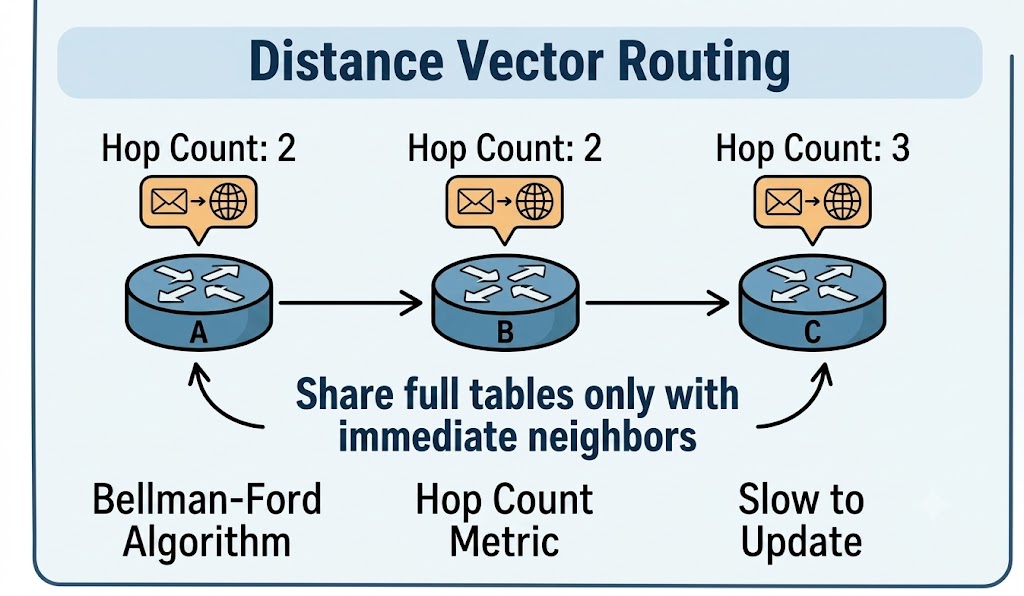
In Distance Vector Routing, routers share knowledge with their immediate neighbors.
Link State Routing
In Link State Routing, every router maintains a complete, highly detailed map of the entire network topology. Unlike Distance Vector, routers only send updates when a physical change actually occurs, saving massive amounts of bandwidth.
It relies on Dijkstra's Shortest Path algorithm. It calculates the absolute best path by evaluating multiple metrics simultaneously, making it highly scalable and incredibly fast.
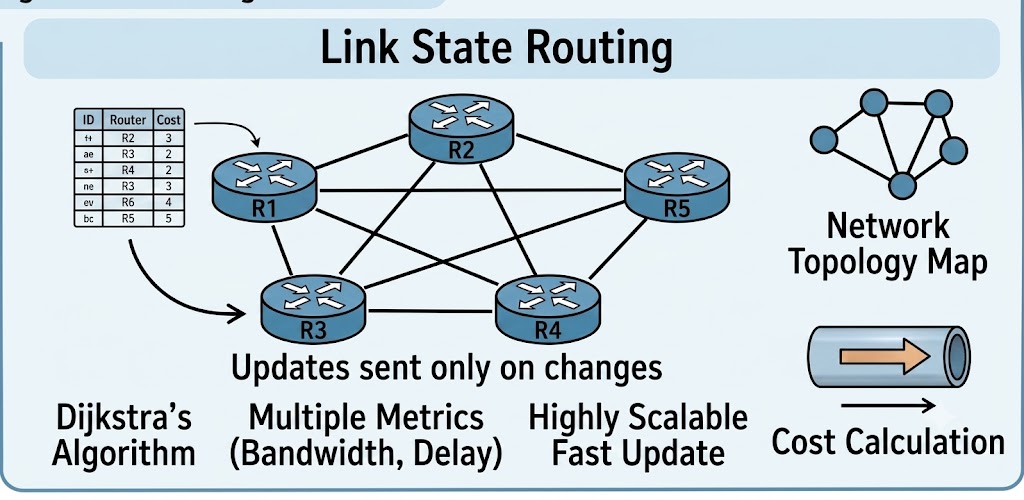
In Link State Routing, routers build a complete topological map of the network.
Key Routing Protocols
- Routing Information Protocol (RIP): A basic Distance Vector protocol that uses hop count as its sole metric. It is limited to a maximum of 15 hops.
- Open Shortest Path First (OSPF): A highly advanced Link State protocol that uses Dijkstra's algorithm. It is widely used in large internal enterprise networks.
- Border Gateway Protocol (BGP): A complex Path Vector protocol used to route data between completely independent autonomous systems. It is literally the backbone routing protocol of the global internet.
Important Routing Metrics
Routers do not just guess the best path. They calculate the 'cost' of a route using specific mathematical metrics.
| Metric | Definition |
|---|---|
| Hop Count | The exact number of intermediate routers a packet must pass through. Fewer hops usually equal a faster path. |
| Bandwidth | The total data capacity of the link. Routers prefer Gigabit fiber cables over slow copper lines. |
| Delay | The exact time it takes for a packet to traverse a specific link. |
| Load | How heavily utilized or congested a specific path currently is. |
| Reliability | The historical stability and error rate of a specific network link. |