

What is Piggybacking?
In bidirectional communication, a receiving device must send an acknowledgement back to the sender to confirm that a data frame arrived correctly. If these acknowledgements are sent as completely separate frames, they consume significant bandwidth.
Piggybacking is an efficiency technique where the acknowledgement is attached directly to the receiver's next outgoing data frame. Instead of sending a standalone control frame, the acknowledgement simply 'rides along' with the data payload.
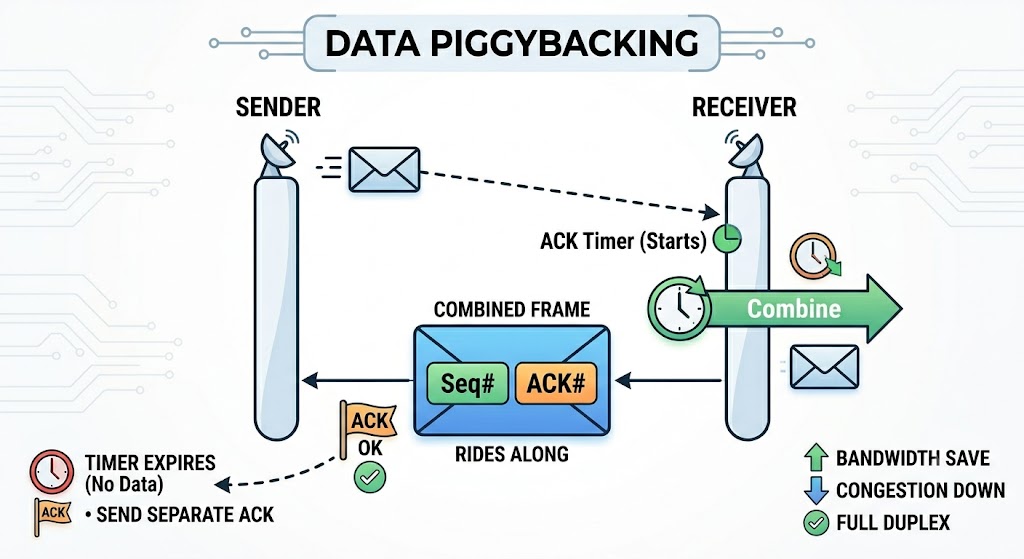
An illustration showing how an acknowledgement frame rides along with a data frame.
Why Piggybacking is Essential
Without piggybacking, every single data frame received generates a standalone acknowledgement frame traveling in the reverse direction. This effectively doubles the number of frames on the network, causing unnecessary overhead.
By combining the acknowledgement with an outgoing data frame, piggybacking drastically reduces network congestion, saves bandwidth, and significantly improves communication efficiency, especially in full duplex systems.
The Timer Mechanism
A critical challenge in piggybacking is determining how long the receiver should wait for an outgoing data frame to be ready.
If the receiver waits indefinitely, the original sender will assume the frame was lost and will waste bandwidth retransmitting it. To solve this, the receiver uses a strict timer.
If an outgoing data frame is prepared before the timer expires, the acknowledgement is piggybacked. If the timer expires and no data is ready, the receiver is forced to send a standalone acknowledgement.
Frame Structure with Piggybacking
To support this technique, the frame header must contain dedicated fields. The header includes the Sequence Number of the current outgoing data, as well as an Acknowledgement Number field indicating the next expected frame from the other side.
Advantages of Piggybacking
- Reduced Network Congestion: Fewer total frames travel across the physical medium.
- Bandwidth Utilization: Eliminates empty frames whose sole purpose is to carry a simple acknowledgement.
- Lower Overhead: Combining data and control information into a single frame reduces the total header overhead.
- Full Duplex Efficiency: It is naturally suited for full duplex communication where both sides continuously exchange data.
Disadvantages of Piggybacking
- Added Complexity: The receiver must manage precise timers and make logical decisions on when to send standalone acknowledgements.
- Delayed Acknowledgements: Waiting for an outgoing data frame inherently delays the acknowledgement, which risks triggering a sender timeout.
- Ineffective for Simplex: If communication is heavily one directional, there are rarely outgoing frames to attach acknowledgements to, rendering the technique useless.
Piggybacking vs Standalone Acknowledgement
| Feature | Piggybacking | Standalone Acknowledgement |
|---|---|---|
| Delivery Method | Attached directly to a data frame. | Sent as a separate control frame. |
| Bandwidth Usage | Highly efficient. | Less efficient due to extra frame overhead. |
| System Complexity | Higher due to strict timer management. | Lower as it responds instantly. |
| Ideal Use Case | Full duplex communication. | Simplex or highly asymmetrical communication. |
Sort the Concepts
Test your knowledge! Sort these traits into the correct acknowledgement strategy.