Learn Data Structures with Javascript – DSA tutorial
Learn Data Structures & Algorithms - From Zero to Hero 🔥

Our impact in Numbers
Empowering developers worldwide to build the next generation of technology through community and education.
0+
Success Stories
0+
Companies Hired
0+
Developer Community
0+
Topics Taught
Our Mission
The mission of this series is to take you from Zero to Hero in Data Structures & Algorithms, with a focus on deep understanding of all the DSA fundamental concepts.
Our goal isn’t just to help you solve problems, but to make you fall in love with algorithms. Every concept is broken down line by line, with clear explanations on how it works, why it works, how to optimize it, finding the time and space complexity and finally converting your approach to code.
We follow a learn-by-doing philosophy. You'll master DSA while practicing a lots of coding problems, starting right from the basics and slowly moving to highly advanced concepts.
By the end of this course, you’ll have the skills and confidence to crack DSA rounds at top companies and approach new DSA problems with ease. This course is intense. It demands your time, consistency, and dedication. But if you commit, it can be a game-changer for your tech career.
Are you ready?
Come join us and become a DSA hero. 🚀
Course Content
Warm-up session for diving into DSA concepts.
Learn the basics of programming with simple concepts explained clearly.
Master functions and conditional logic with if-else statements.
Learn looping constructs to repeat code effectively.
Deep dive into advanced loop techniques and nested loops.
Find the second largest number in an array efficiently.
Learn how to implement nested loops for complex patterns.
Draw star patterns using nested loops for practice.
Count the number of digits in an integer.
Check if a string or number is a palindrome.
Reverse the digits of an integer programmatically.
Remove duplicate elements from a sorted array.
Remove specific elements from an array.
Reverse the characters of a string.
Maximize profit from stock prices using smart strategy.
Merge two sorted arrays into one sorted array.
Move all zeros to the end of the array without changing order.
Find the maximum streak of 1s in a binary array.
Find the missing number in a sequence from 1 to N.
Find the unique element in an array where all others are repeated.
Understand the basics of recursion with clear explanations and examples.
Calculate the sum of the first n natural numbers using recursion.
Find the sum of all elements in an array using simple logic.
Learn how to calculate factorials using recursion.
Solve Power of Two problem with recursion and logic.
Master recursion with deep insights, patterns, and examples.
Find an element in an array using linear search.
Find an element in a sorted array using binary search.
Sort an array using the bubble sort algorithm.
Sort an array using the selection sort algorithm.
Sort an array using the insertion sort algorithm.
Learn how Merge Sort works using recursion and divide & conquer.
Get started with the basics of Linked Lists.
Learn how to design and implement your own Linked List.
Learn to insert nodes into a Linked List at various positions.
Understand node deletion in a Linked List.
Find the middle element in a Linked List efficiently.
Reverse a Linked List in-place using iteration.
Detect cycles in a Linked List using extra space.
Detect cycles with Floyd’s Tortoise & Hare algorithm.
Check if a Linked List is a palindrome.
Find the intersection node of two Linked Lists.
Remove nodes with a specific value from a Linked List.
Remove the nth node from the end using a two-pass method.
Remove the nth node from the end in one pass using two pointers.
Remove consecutive duplicates from a sorted Linked List.
Rearrange nodes based on their position (odd/even index).
Add two numbers represented as Linked Lists.
Merge two sorted Linked Lists into one.
Rotate a Linked List to the right by k places.
Swap every two adjacent nodes in a Linked List iteratively.
Recursively swap every two adjacent nodes in a Linked List.
Find the length of the last word using a basic loop approach.
Optimized one-pass solution to find the last word’s length.
Find words from a list that contain a specific character.
Count how many stones are also jewels.
Identify the most frequent vowel and consonant in a string.
Split a string into maximum balanced substrings.
Reverse parts of a string based on a pattern.
Check palindrome by cleaning and reversing a string.
Use two-pointer technique to validate palindrome.
Find the largest odd number that can be formed from a string.
Find the longest common starting substring among strings.
Check if two strings are anagrams of each other.
Check if two strings have a one-to-one character mapping.
Group words that are anagrams using sorted string keys.
Group anagrams using character frequency hash as key.
Get introduced to the fundamentals of Stacks and Queues.
Explore basic operations on stacks and queues hands-on.
Build a stack using two queues.
Implement a stack using a single queue cleverly.
Simulate a queue using two stacks.
Check if a string of parentheses is valid.
Design a stack that supports retrieving the minimum in O(1).
Remove outermost parentheses using a stack-based approach.
Remove outer parentheses without using a stack.
Evaluate mathematical expressions in postfix notation.
Find the next greater element for each number in an array.
Find how many days until a warmer temperature.
Solve the circular version of Next Greater Element.
Simulate the rotting process of oranges using BFS.
Find the square root of a number using binary search.
Learn the safe and optimal way to find the middle index.
Use binary search to guess a hidden number.
Search an element in a rotated sorted array.
Identify the first bad version using binary search.
Locate a peak element using binary search.
Find the smallest element in a rotated sorted array.
Find the first and last index of a target in a sorted array.
Optimized approach for finding first and last index of target.
Find the peak element in a mountain-shaped array.
Find the single non-duplicate element in a sorted array.
Find the k elements closest to a target in a sorted array.
Find two numbers that add up to a target using hashing.
Solve Two Sum with a sorted array using two pointers.
Check if one string is a subsequence of another.
Locate the first occurrence of a substring in a string.
Efficient substring search using the KMP algorithm.
Find the intersection node of two linked lists using two pointers.
Maximize water between two lines using two pointers.
Find all unique triplets that sum to zero.
Calculate how much water can be trapped after rain.
Find the longest substring with all unique characters.
Maximize the length of a repeating character substring.
Check if one string contains a permutation of another.
Find the max value in every window of size k.
Understand what trees are and their core properties.
Explore preorder, inorder, and postorder tree traversals.
Perform preorder traversal using recursion.
Implement inorder and postorder recursively.
Use a stack to perform preorder traversal iteratively.
Inorder traversal using a stack instead of recursion.
Use two stacks for iterative postorder traversal.
Efficient postorder traversal using just one stack.
Understand DFS vs BFS in binary trees.
Implement level order traversal using a queue.
Perform level order traversal recursively.
Find the max depth of a binary tree.
Check if a path adds up to a target sum.
Check if a binary tree is symmetric using recursion.
Check symmetry in a binary tree using BFS.
Flip a binary tree by swapping left and right nodes.
Check if two binary trees are exactly the same.
Check if a binary tree is height-balanced.
Find the longest path between any two nodes.
Traverse a binary tree in zigzag order.
Check if one binary tree is a subtree of another.
Find the lowest common ancestor of two nodes.
Print the nodes visible from the right side.
Count nodes that are greater than all previous nodes on the path.
Connect each node to its next right node in the same level.
Find the path in a tree with the maximum sum.
Learn the basics of Binary Search Trees.
Check if a tree is a valid BST.
Search for a value in a Binary Search Tree.
Insert a new node in a BST.
Find the kth smallest element in BST.
Find the lowest common ancestor in a Binary Search Tree.
Understand the fundamentals of Heaps.
Learn how to build a heap from an array.
Insert an element into a heap and maintain the heap property.
Remove the root and restore heap order.
Understand the Heap Sort algorithm step-by-step.
Implement Heap Sort in code.
Explore advanced insights into Heap Sort.
Learn how priority queues work using heaps.
Implement a priority queue in code.
Find the kth largest element using a heap.
Maintain the kth largest value as numbers stream in.
Simulate a stone smashing game using heaps.
Find the k most frequent elements in an array.
Find the kth smallest element in a sorted matrix.
Detect cycles in a Linked List using extra space.
Check if a Linked List is a palindrome.
Find the intersection node of two linked lists using two pointers.
Remove consecutive duplicates from a sorted Linked List.
Find words from a list that contain a specific character.
Count how many stones are also jewels.
Identify the most frequent vowel and consonant in a string.
Check palindrome by cleaning and reversing a string.
Check if two strings are anagrams of each other.
Check if two strings have a one-to-one character mapping.
Group words that are anagrams using sorted string keys.
Group anagrams using character frequency hash as key.
Find the next greater element for each number in an array.
Solve Two Sum with a sorted array using two pointers.
Locate the first occurrence of a substring in a string.
Efficient substring search using the KMP algorithm.
Check if one string contains a permutation of another.
Find the longest substring with all unique characters.
Find the max value in every window of size k.
Understand the core concept of backtracking.
Generate all subsets of a set.
Find all combinations of numbers.
Generate all permutations of a list.
Subsets with duplicate elements.
Find all combinations that sum to a target.
Combination sum with single-use elements.
Find k numbers that sum to n.
Generate letter combinations from digits.
Unique permutations with duplicates.
Partition a string into palindromes.
Search a word in a grid.
Place queens safely on a chessboard.
Learn the basics of the Greedy Algorithm technique with simple examples.
Solve the classic Two City Scheduling problem using a greedy approach.
Understand how to maximize content children by assigning cookies efficiently.
Learn how to apply greedy techniques to manage change in the Lemonade Stand problem.
Master stock trading with multiple transactions using greedy techniques.
Learn how to insert a new interval into a set of non-overlapping intervals.
Understand how to merge overlapping intervals into non-overlapping ones.
Split a string into partitions where each character appears in at most one part.
Find the minimum number of intervals to remove to avoid overlaps.
Schedule tasks efficiently with cooldown periods using greedy + heaps.
Learn how to find the starting gas station index to complete a circuit.
Check if carpooling is possible given trips and capacity.
Distribute candies fairly using a two-pass O(n) approach.
Distribute candies fairly using a two-pass O(n) approach.
Understand the basics of Dynamic Programming and its importance.
Solve Fibonacci efficiently with Dynamic Programming.
Compare top-down and bottom-up DP techniques.
Learn how to solve the classic Climbing Stairs DP problem.
Solve minimum cost climbing stairs with DP.
Maximize robbery amount without robbing adjacent houses.
Solve House Robber II with circular houses constraint using DP.
Learn recursive top-down DP for the Coin Change problem.
Solve Coin Change with bottom-up DP using iteration.
Count palindromic substrings using DP.
Find the longest palindromic substring with DP.
Solve Decode Ways problem with recursion and DP.
Find maximum subarray sum using Kadane’s Algorithm.
Solve Maximum Product Subarray with DP approach 1.
Optimize Maximum Product Subarray with approach 2.
Solve the classic Word Break problem by checking if a given string can be segmented into valid words from a dictionary
Solve the Longest Increasing Subsequence problem by finding the length of the longest strictly increasing sequence in an array.
Tackle the Partition Equal Subset Sum problem by checking if an array can be split into two subsets with the same total sum.
Solve the Coin Change II problem by finding how many ways you can make a given amount using an unlimited supply of coins
Solve the Unique Paths problem by finding the total number of ways to move from the top-left to the bottom-right of a grid.
Understand what graphs are and why they matter in DSA.
Learn the Breadth First Search (BFS) algorithm step by step.
Master the Depth First Search (DFS) algorithm for graphs.
Check if a path exists between two nodes using BFS.
Implement Depth First Search recursively in graphs.
Find all possible paths from source to target using DFS.
Rebuild an itinerary using graph traversal.
Detect if a cycle exists in an undirected graph.
Perform Topological Sorting using DFS.
Learn Kahn’s Algorithm for Topological Sorting using BFS.
Overview of shortest path algorithms in graphs.
Find the shortest path in an unweighted graph using BFS.
Understand Dijkstra’s Algorithm for weighted graphs.
Implement Dijkstra’s Algorithm in code.
Find shortest paths with negative weights using Bellman-Ford.
Code the Bellman-Ford Algorithm step by step.
Understand the Floyd-Warshall Algorithm for all-pairs shortest paths.
Implement the Floyd-Warshall Algorithm step by step in code.
Compare Dijkstra, Bellman-Ford, and Floyd-Warshall algorithms.
Understand the concept of a Minimum Spanning Tree (MST).
Learn Prim’s Algorithm for building MSTs.
Implement Prim’s Algorithm in code.
Learn the Union-Find data structure for efficient set merging.
Understand Kruskal’s Algorithm for MST construction.
Implement Kruskal’s Algorithm using Union-Find.
Compare Prim’s and Kruskal’s MST algorithms.
Find the minimum operations to connect all computers in a network.
Find the cheapest flight within a limited number of stops.
Count the number of shortest paths to reach the destination.
Connect all points with minimum total cost.
Understand the fundamental concept and purpose of a Trie data structure.
Design the TrieNode class and the overall Trie structure.
Implement the core operations: Insert, Search, and StartsWith.
Analyze the efficiency of Trie operations and their memory footprint.
Learn how Quick Sort works using divide and conquer.
Understand the basics of Counting Sort.
Learn the logic behind stable Counting Sort.
Implement stable Counting Sort in code.
Sort numbers digit by digit using Radix Sort.
Distribute elements into buckets for efficient sorting.
Quick revision guide for sorting and DSA interviews.
Have doubts about this course?
Instructor

Akshay Saini
Founder, NamasteDev | Former Software Engineer at Uber & Paytm
Akshay Saini, founder of NamasteDev.com, who previously worked as a software engineer at Uber & Paytm. Akshay has over 13+ years of experience in the software industry and has been guiding students to become a better software Engineer. Well known for his famous playlist named Namaste JavaScript, he has taught over 20 lakhs+ students across the globe. All the concepts in this course are taught by Akshay himself.
Akshay is extremely mindful of the technical queries and obstacles faced by students aspiring towards a career in development. Drawing from his own experiences, he has crafted courses designed to offer a straightforward yet effective problem-solving methodology. As a mentor to over 20 lakh+ students, he has established a tech community that facilitates interaction among professionals across different levels of expertise.
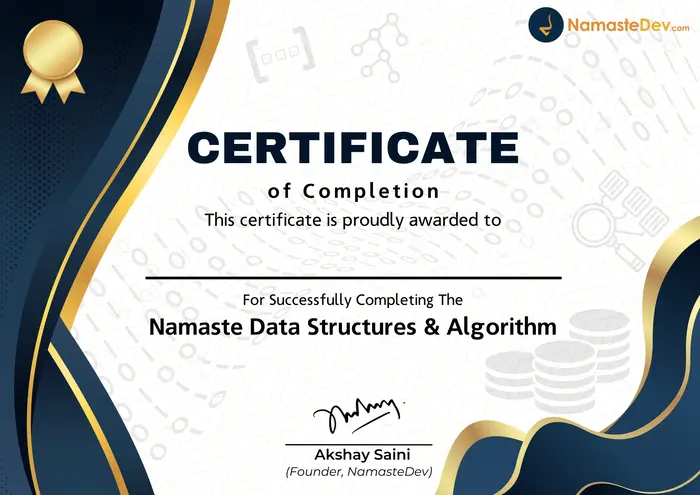
Course Certificate
Earn Your OfficialNamaste DSACertificate
Complete Namaste DSA and receive a personalised certificate recognising your learning journey.

Official Namaste DSA Certificate
Recognise your learning and showcase your achievement.
Add it to your resume or portfolio
Share it with your LinkedIn network
Issued by NamasteDev upon course completion
Verified e-certificate with unique ID
Lifetime Access

Unlock Course For Life!
Enroll once and gain unlimited lifetime access to this course. No subscriptions, no renewals, no hidden fees. Learn at your own pace, revisit complex topics anytime, and stay updated with future additions - all at no extra cost.
AI Resume Reviewer


Get the AI Resume Reviewer absolutely FREE
Notes

Beautifully Curated Notes Just for You ❤️
Enhance your learning experience with thoughtfully designed, easy-to-read notes crafted to simplify complex concepts.
Enjoy the power of reading and watching videos together your satisfaction is our priority!
Note: Some episodes may not have notes yet - we're working hard to add them as soon as possible.
Free DSA Practice Sheet
Namaste DSA Sheet 🚀
We've handpicked the most impactful DSA questions to help you crack FAANG companies and top Product Based Companies (PBCs). Get access to company-wise and difficulty-wise questions, curated resources, and track your progress to go from beginner to pro!
7 Days Refund Policy

Try It, Risk Free ❤️
We are confident you'll love this course. But if it's not the right fit, no worries! Get a refund within 7 days - No questions asked.
Best DSA course for Placement
Master Core Fundamentals
Build a rock-solid foundation that top tech companies look for. Namaste DSA goes deep into the "why" and "how" behind every concept.
Crack Technical Rounds
Learn the exact patterns, problem-solving techniques, and practical skills to confidently tackle difficult interview questions.
Industry-Ready Skills
Move beyond theory. Write clean, scalable, and optimized code just like developers do in top product-based companies.
Stand Out from the Crowd
Gain the confidence and the portfolio to stand out to recruiters, clear technical screens, and land your dream job.
7-Day Refund
Included across the learning experience
Lifetime Access
Included across the learning experience
Certificate
Included across the learning experience
Community Access
Included across the learning experience
Future Course Updates
Included across the learning experience
Expert Guidance
Included across the learning experience
High Quality Videos
Included across the learning experience
In-depth Explanation
Included across the learning experience
Interview Tips
Included across the learning experience
Everything Included in Namaste DSA
Packed With Value, Built For Results
"Not just a course - a complete ecosystem designed to take you from zero to job-ready."
What You’ll Learn
Skills That Actually Get You Hired
"Every concept you learn here is something interviewers actively test for."
Basically, I’ll teach you everything I’ve learned over the years from solving numerous problems to preparing for top tech interviews. Everything I know about Data Structures and Algorithms, distilled into one powerful course. ❤️
We’ll dive deep into each Data Structure and Algorithm by solving hundreds of problems no slides, no shortcuts just real coding, real logic, and hands-on learning. 🚀
We’ll start from absolute ZERO and build up to confidently solving even the most complex DSA questions. This is your journey from Zero to Hero in Data Structures and Algorithms. 😎
This is one of the few structured DSA courses in the industry that teaches you the why, how, and where behind every concept in a way that’s practical, intuitive, and interview-ready.
And yes, you’ll have lifetime access to all future content updates and bonus sessions as the series evolves!
Sounds cool, isn't it?
Our Testimonials
Top Companies Where Our Students Work


And Many More...
Interview Stories
UPDATE: SERIOUSLY GOT A JOB BECAUSE OF THIS! Went to an interview. Interviewer: 'Write an example of closure.' Me: *Writes the example*. Interviewer: 'Namaste JavaScript? 🤔' Me: '😐'. Interviewer: 'Even I had the same example in mind!' We high-fived each other. Happily working ever after! 🧱
I was explaining Hoisting with a demo. Suddenly the interviewer said, 'You watched Namaste JavaScript videos, right?' I said yes. He said, 'OK, let's move to the next question. Your concept is clear. I study from there too!' You're trending, sir! 🚀
I had a JS interview a while ago and noticed most questions were straight from your series. This series is amazing; I've never felt JavaScript like this before! ✨
Frequently Asked Questions
Namaste DSA is a comprehensive Data Structures and Algorithms course that takes you from zero to hero in DSA. It focuses on deep understanding of fundamental concepts through hands-on coding, visualization, and beginner-friendly explanations.
Yes, Namaste DSA starts from absolute zero and builds up gradually. The course begins with basic programming concepts like functions, loops, and conditionals, making it accessible even for those new to coding.
Namaste DSA allows you to choose your preferred programming language. The course is designed to teach concepts in a language-agnostic way, focusing on understanding algorithms and data structures rather than language syntax. Although the instructor uses JavaScript for code explanation.
The course covers all fundamental data structures including arrays, linked lists, stacks, queues, trees, binary search trees, heaps, graphs, hash tables, and advanced structures needed for coding interviews.
Namaste DSA covers searching, sorting, recursion, dynamic programming, greedy algorithms, backtracking, graph algorithms, string algorithms, and various problem-solving techniques essential for coding interviews.
Yes, Namaste DSA is specifically designed to help you crack DSA rounds at top companies. By the end of the course, you'll have the skills and confidence to approach coding interview problems with ease.
The course explains time and space complexity analysis for every algorithm and data structure. You'll learn Big O notation, how to analyze algorithm efficiency, and optimize solutions.
Yes, the course includes practice problems and challenges to test your understanding. After learning concepts, you'll solve problems to reinforce your learning and build problem-solving skills.
Every concept is broken down line by line with clear explanations on how it works, why it works, how to optimize it, finding complexity, and converting approach to code. The goal is to make you fall in love with algorithms.
Namaste DSA is an intensive course that demands time, consistency, and dedication. However, if you commit to it, the course can be a game-changer for your tech career and interview preparation.